Self Employment
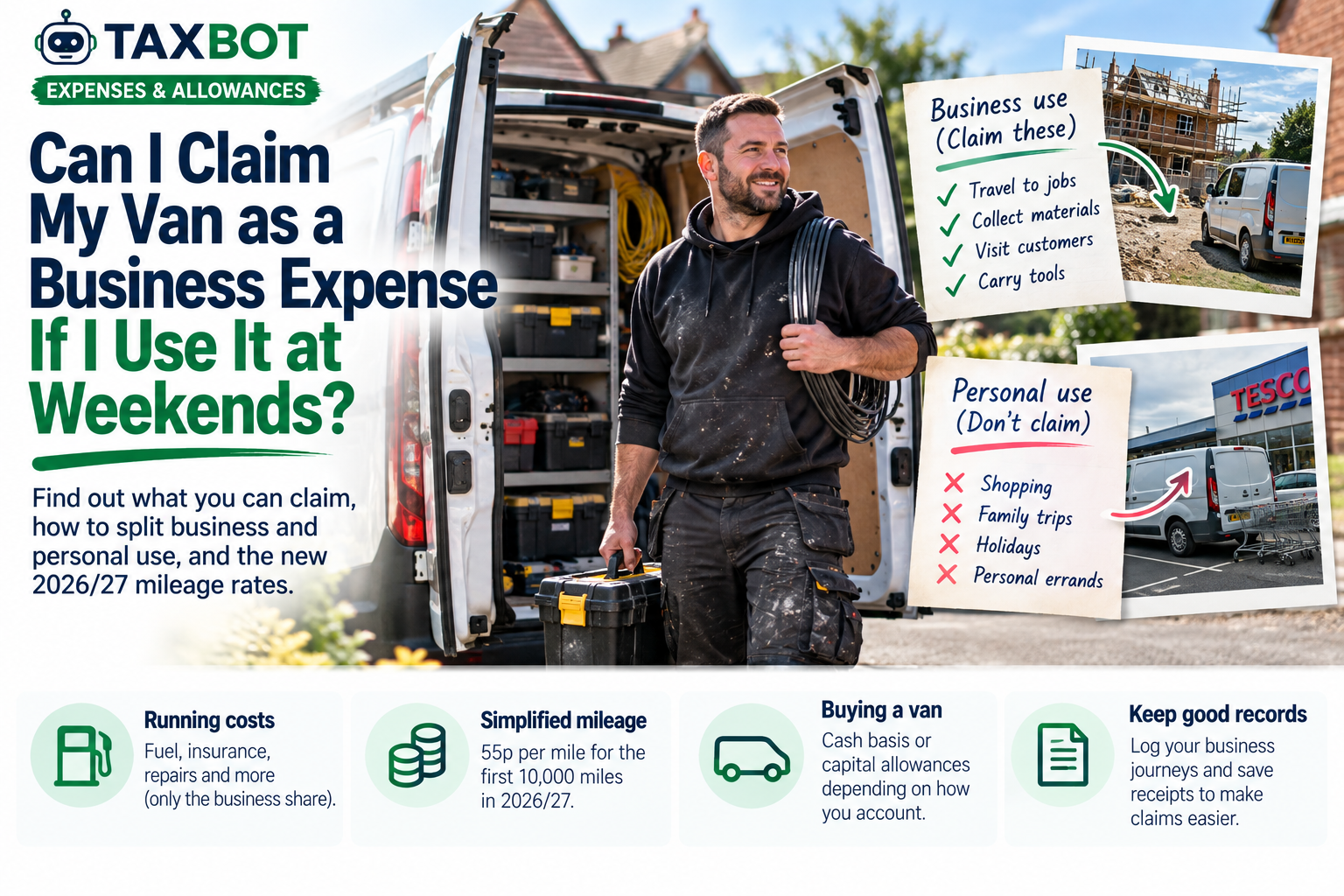
Can I Claim My Van as a Business Expense If I Use It at Weekends?
Can I Claim My Van as a Business Expense If I Use It at Weekends?
You bought your van for work. It's full of tools during the week, takes you from one job to another and probably has a few scratches to prove it.
But come Saturday, it's also quite handy for picking up a new sofa, taking the kids out or doing the weekly shop.
So where does that leave you with HMRC?
Can you still claim your van as a business expense if you're using it for personal journeys too?
Yes, you usually can. Using your van outside work doesn't automatically stop you claiming business expenses. What matters is that you only claim the costs you're entitled to, based on how the van is actually used.
There are also different rules for claiming the cost of buying your van and claiming the money you spend keeping it on the road.
And if you're self-employed, choosing the wrong method of claiming vehicle expenses could mean missing out on tax relief.
Let's look at how it works.
You don't have to use your van exclusively for work
Imagine you're a self-employed electrician.
Monday to Friday, you're driving between customers' homes, picking up materials from wholesalers and carrying your tools from one job to the next.
On Saturday morning, you drive to the supermarket. On Sunday, you take the family to visit relatives.
Does that make your van a personal vehicle rather than a business one?
No. It's being used for both.
HMRC recognises that sole traders sometimes use the same vehicle for business and personal reasons. The important thing is separating those two types of use.
Your trip to collect electrical fittings for a customer's kitchen is a business journey.
Your trip to collect your own new television isn't.
And parking outside your house with tools still in the back doesn't automatically turn a personal trip into a business journey.
The key question is why you made the journey, not simply whether you were driving a work van.
What van expenses can you actually claim?
If you work out your expenses using the actual-cost method, you can generally claim the business share of costs such as:
Diesel, petrol or electricity used to run the van.
Vehicle insurance.
MOT tests, servicing and repairs.
Replacement tyres and other maintenance.
Vehicle Excise Duty (road tax).
Breakdown cover.
Van hire or qualifying leasing costs.
Business parking charges and tolls.
However, you cannot claim the personal share of those costs.
Parking fines and other penalties aren't allowable business expenses either.
What about the cost of buying the van itself?
That's treated separately, and we'll come to that shortly.
Let's say you use your van 75% for work
Here's a realistic example of how the figures might look.
A self-employed plasterer uses his van throughout the year to travel to jobs and collect materials.
He also uses it for family trips and other personal journeys.
At the end of the year, his mileage records show:
Type of journey
Miles
Business journeys
9,000
Personal journeys
3,000
Total mileage
12,000
That means 75% of the miles were for business.
Now let's look at what he spent keeping the van running.
Annual van expense
Total cost
Fuel
£2,900
Insurance
£1,200
Repairs and servicing
£800
Road tax
£360
Breakdown cover
£140
Total
£5,400
If mileage is a reasonable way to allocate these costs, his calculation would be:
£5,400 × 75% = £4,050
He could potentially claim £4,050 of those running expenses against his self-employed profits.
The remaining £1,350 relates to personal use, so it isn't an allowable business expense.
This example assumes the costs are otherwise allowable and the van is owned by the sole trader, rather than a limited company.
Notice something important here: £4,050 is a tax deduction, not a £4,050 tax refund.
It reduces the amount of profit on which tax is calculated. The actual tax saving depends on his circumstances.
And this example only covers running costs, not tax relief on buying the van.
There's another option: claiming business mileage instead
Not everyone wants to add up fuel receipts, insurance bills and repair invoices to calculate their vehicle expenses.
If you're eligible, HMRC allows self-employed people to use simplified mileage expenses.
Rather than claiming a percentage of the van's actual costs, you claim a fixed amount for every qualifying business mile.
The mileage rates changed in April 2026
For the 2026/27 tax year, the simplified mileage rates for cars and vans are:
Business mileage
Rate
First 10,000 business miles
55p per mile
Each business mile above 10,000
25p per mile
Before 6 April 2026, the rate for the first 10,000 business miles was 45p.
That increase matters, particularly if you spend a lot of time driving between jobs.
Let's go back to our plasterer.
He drove 9,000 qualifying business miles.
Using the 2026/27 simplified mileage rate:
9,000 × £0.55 = £4,950
That gives him a potential vehicle expense deduction of £4,950 using the mileage method.
But here's the catch.
If you claim the simplified mileage rate, you cannot also claim the van's fuel, insurance, servicing, repairs or purchase cost separately. Those costs are already accounted for within the mileage rate.
Qualifying business parking and toll charges can generally be claimed separately.
And you cannot simply switch methods every year depending on which gives you the biggest deduction. Once you start using the simplified mileage method for a particular van, you normally have to keep using it while that van remains in the business.
You also cannot use simplified mileage for a vehicle if you've already claimed capital allowances or deducted its purchase cost as a business expense.
That means it's worth comparing your options before making your first claim, especially if you've recently bought an expensive van.
Can you claim the actual cost of buying your van?
Potentially, yes.
But buying a van is not quite the same as buying a box of screws or a new drill.
The treatment depends on how you account for your business income and expenses.
If you use cash basis accounting
Cash basis is the default accounting method for many sole traders.
Under this method, the qualifying cost of buying a van can generally be treated as a business expense, subject to the business-use restriction and the relevant rules.
For example, suppose you buy a used van for £12,000 and use it 80% for your business.
An illustrative business-use calculation would be:
£12,000 × 80% = £9,600
That could give you a £9,600 business expense deduction, assuming the purchase is eligible and appropriately recorded.
That doesn't mean HMRC sends you £9,600. It means you may deduct that amount when calculating your taxable business profit.
The position can be different if you purchased the van under finance, introduced a vehicle you already owned into the business, or have previously claimed tax relief on it.
If you use traditional accounting
If you use traditional accounting, the purchase will normally be dealt with through capital allowances rather than simply deducting the purchase price as an everyday running expense.
A qualifying van may be eligible for the Annual Investment Allowance, subject to the rules and any adjustment for private use.
This can be particularly important when buying an expensive vehicle.
The exact amount you can claim depends on the purchase, the accounting treatment, business use and whether you've claimed relief before.
A useful rule to remember: buying a van for £12,000 doesn't automatically mean you can deduct £12,000 if you also use it privately.
And if you claim relief for the purchase, you generally cannot then use simplified mileage for that same vehicle.
What if you're still paying off the van?
This is where things can get confusing.
Perhaps you're paying £350 a month for your van and assumed you could simply record every monthly payment as a business expense.
That isn't necessarily how it works.
A vehicle bought using a loan or hire purchase can have different tax treatment from one rented under a qualifying lease.
Loan capital repayments are not normally deductible as ordinary running expenses. Qualifying finance interest may be treated separately.
With hire purchase, tax relief on the vehicle's cost may be available under the relevant rules, but it doesn't follow that each monthly instalment is an allowable expense in full.
Leasing arrangements also need to be considered separately.
So before claiming the monthly payments, check exactly what agreement you signed.
The words hire purchase, personal contract purchase and lease can make a real difference.
Does driving from home to a building site count as business mileage?
This is another area where tradespeople can easily make mistakes.
You might assume that because you're travelling to work, the mileage must be a business expense.
But HMRC distinguishes between business travel and ordinary commuting.
For example, travelling from your home to a fixed, regular place of work may count as commuting rather than allowable business travel.
On the other hand, a self-employed builder who operates from home and travels to different temporary customer sites may be entitled to claim those journeys, depending on the circumstances.
Consider these two situations.
Situation one: You're a self-employed plumber who works from a genuine home business base and visits different customers throughout the week. Journeys to those jobs may qualify as business travel.
Situation two: You're a subcontractor who travels to the same regular workplace every day. You should not automatically assume that all those journeys qualify simply because you're registered as self-employed.
HMRC looks at the actual working arrangements, including where your business is based and the nature of the journeys.
Also, don't assume the employee rules about temporary workplaces automatically apply to you as a sole trader. The rules are not identical.
If you're working under CIS and spending months at the same construction site, it's worth checking your travel arrangements carefully before claiming.
What if you stop at the supermarket on the way home?
This is where real life gets a little messier than the examples in tax guides.
Suppose you're finishing a job and driving home in your van.
You stop at a supermarket that's a short distance off your normal route.
Can you claim the entire journey?
You need to look at the purpose of the journey and whether any part is identifiable as private travel.
If the original work journey is allowable and you make a separate personal detour, you generally shouldn't include the extra personal mileage in your business claim.
If a journey itself serves both personal and business purposes, the position can be more complicated. Simply adding a work-related stop to a personal trip doesn't automatically make the entire journey allowable.
The easiest way to avoid confusion is to record where you travelled, why you went there and how many miles were genuinely for business.
Do you need to keep every fuel receipt?
That depends on how you're claiming.
If you use actual vehicle costs, you should keep evidence of the relevant expenses, such as fuel receipts, insurance invoices and servicing bills.
If you use the simplified mileage method, you don't need fuel receipts to substantiate the mileage-rate calculation itself, but you do need reliable records of your business journeys.
A useful mileage record includes:
Date of the journey.
Where you travelled from and to.
Purpose of the journey.
Number of business miles.
Customer, job or site reference where relevant.
For example:
14 October 2026 — Home business base to customer in Watford and return — bathroom fitting — 42 qualifying business miles.
That tells you far more than a note saying "diesel £65".
Whether you use a notebook, spreadsheet or bookkeeping software, keeping the information up to date is much easier than trying to remember six months of journeys when your tax return is due.
Where TaxBot fits in
TaxBot is designed to help sole traders keep track of business transactions and receipts without leaving everything until tax-return season.
For someone using a van every day, the practical benefit is building the habit of recording costs as they happen.
But recording a receipt and establishing whether an expense is tax-deductible are not the same thing. You still need to identify business use, select the correct claiming method and keep suitable supporting records.
A useful routine is to check your vehicle expenses and business mileage every week rather than once a year.
What if you're VAT registered?
Everything we've covered so far mainly concerns expenses for Income Tax purposes.
VAT is a separate consideration.
If you're VAT registered, the rules for reclaiming VAT on a van and its running costs depend on the type of vehicle, your business use and your VAT arrangements.
You shouldn't assume that because 80% of an expense qualifies for Income Tax, exactly the same VAT treatment automatically applies.
The distinction is especially important when purchasing a vehicle, as well as for businesses using the VAT Flat Rate Scheme.
If you're VAT registered, check the VAT rules separately before making a claim.
One more thing: is your vehicle definitely a van for tax purposes?
Most people know whether they drive a van or a car.
HMRC's classification rules can sometimes be less straightforward.
This matters particularly with some double-cab pick-ups and vehicles that can carry both passengers and goods.
The tax treatment of double-cab pick-ups changed for many purchases from April 2025, so don't rely on older articles claiming that every one-tonne pick-up automatically qualifies as a van.
If your vehicle isn't a conventional goods van, check its classification before assuming the van purchase rules apply.
So, should you claim mileage or actual costs?
There isn't one answer that suits every sole trader.
If you already own a relatively inexpensive van and drive a lot of qualifying business miles, simplified mileage could be worth considering.
If you've recently bought an expensive van or have substantial running costs, claiming actual expenses and the appropriate purchase relief may be more suitable.
The important thing is to compare the rules and likely deductions over the period you'll use the vehicle, not just one year's fuel bills.
Before choosing, ask yourself:
How many business miles do I genuinely drive?
How much does the van cost to buy and run?
How often do I use it privately?
Have I already claimed tax relief for the purchase?
Am I using cash basis or traditional accounting?
Those answers will help you work out which options are available.
The bottom line
If your van spends Monday to Friday carrying tools and taking you to jobs, then gets used for shopping or family trips at weekends, you're not automatically disqualified from claiming it as a business expense.
You just need to be fair and accurate about the business and personal use.
Keep a record of your journeys, understand the difference between mileage and actual expenses, and make sure you don't claim the same vehicle costs twice.
For many tradespeople, a van is one of their biggest business expenses. It's worth getting the tax treatment right rather than guessing when January comes around.
This article focuses on UK self-employed sole traders. Different rules can apply to limited companies, company vans and employees.
Disclaimer: This article is for general information only and does not constitute individual tax or financial advice. Tax rules and eligibility depend on your circumstances. Check current HMRC guidance or speak to a qualified UK accountant before making significant vehicle expense or capital allowance claims.
Handle your MTD returns automatically
Snap receipts, log income, submit to HMRC — all from Telegram.
Try TaxBot →