HMRC Guides
HMRC Says I Owe Tax but I’m PAYE – Why?
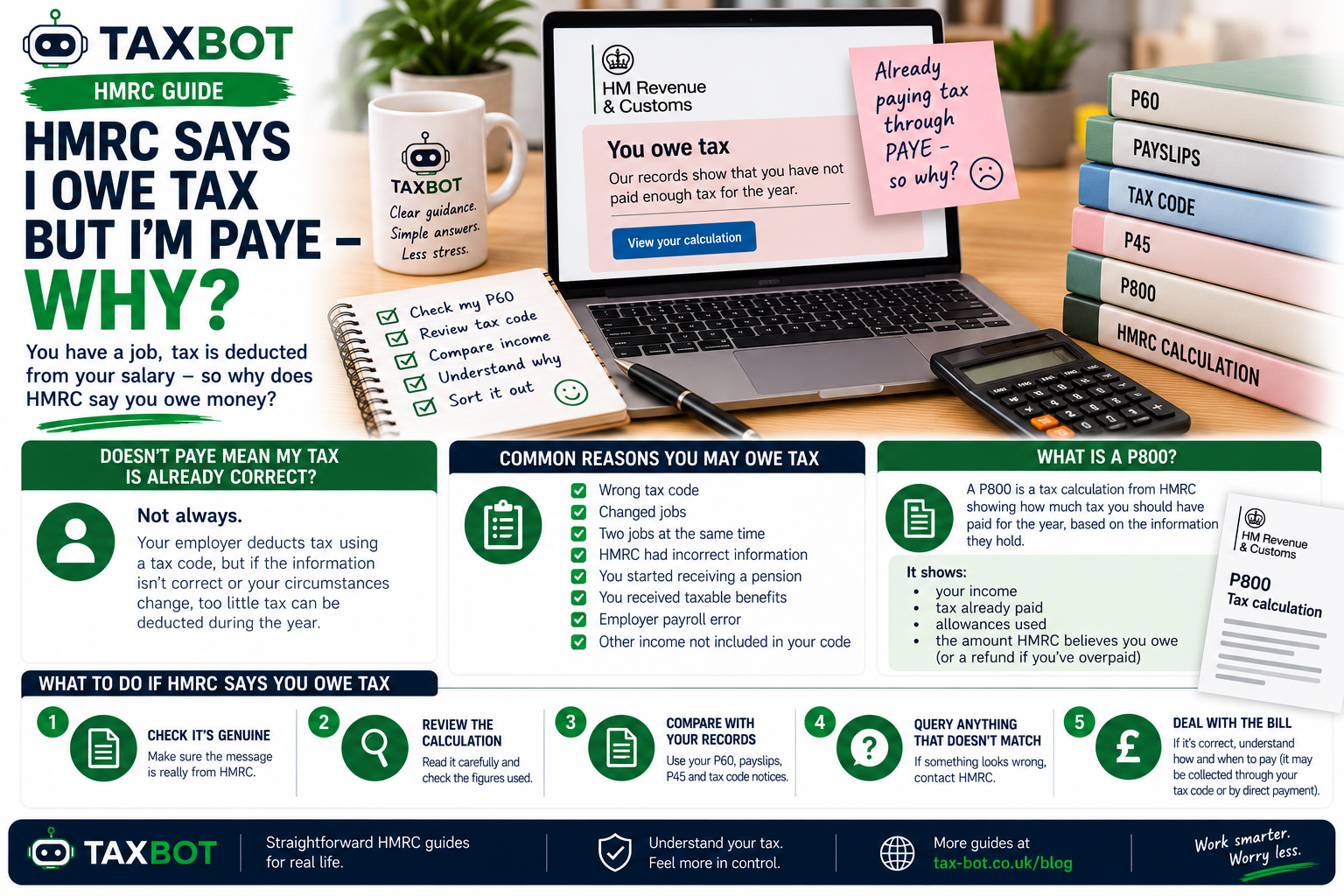
HMRC Says I Owe Tax but I’m PAYE – Why?
You have a normal job.
Tax comes out of your wages every month.
You've never thought of yourself as someone who needs to deal with a tax bill.
Then HMRC tells you:
You haven't paid enough tax.
Your first reaction might understandably be:
"How can I owe HMRC money when my employer already takes tax from my salary?"
PAYE is designed to collect tax from your earnings as you're paid, but it doesn't guarantee that the final amount deducted during the year will always exactly match the tax you actually owe.
Here's why an underpayment can happen — and what you should do if HMRC says you owe money.
Doesn't PAYE Mean My Tax Is Automatically Correct?
Not necessarily.
Under PAYE, your employer uses a tax code to work out how much Income Tax to deduct from your pay.
But that calculation depends on HMRC and your employer having the correct information.
Your circumstances can also change during the year.
If the information being used isn't quite right, too little tax can sometimes be deducted.
HMRC may discover the difference when it reviews your tax position after the end of the tax year.
Why Would I Owe Tax Through PAYE?
There isn't one single reason.
Some of the more common situations include:
You had the wrong tax code
You changed jobs
You were paid by two employers during the same period
HMRC had incorrect information about your income
You started receiving a pension
You received certain taxable benefits
Your tax code changed during the year
Your employer's payroll information was incorrect
Sometimes several things happen during the same tax year.
Your Tax Code Could Have Been Wrong
Your tax code tells your employer how much tax-free income or other adjustments to take into account when calculating your PAYE tax.
If the code gives you too much tax-free income, not enough tax may be deducted.
For example, HMRC might have incorrect information about:
Your expected salary
Another job
A pension
Benefits from your employer
Previous employment
Other income
The difference might be relatively small each month.
But over an entire tax year, it can add up.
Changing Jobs Can Cause Problems
Changing jobs is another common reason for PAYE confusion.
Suppose you leave Employer A and start working for Employer B.
Depending on when you're paid, information provided to the new employer and the tax code being operated, your PAYE position may not immediately line up perfectly.
You could even receive payments from your old and new employer during the same month.
HMRC may later reconcile the figures and discover that you paid less tax overall than was actually due.
What If I Had Two Jobs?
Having two jobs can also affect your tax position.
You only have one Personal Allowance.
You don't automatically get the full tax-free allowance against:
Job 1
and then another full allowance against:
Job 2.
HMRC normally allocates your allowances through your tax codes.
If those codes aren't set correctly, you could end up paying too little tax during the year.
What Is a P800?
After the tax year ends, HMRC checks information it holds about certain PAYE taxpayers.
If you've paid the wrong amount of tax, HMRC may send you a tax calculation known as a P800.
The calculation should show things such as:
Your income
Tax you've already paid
Allowances used
The amount HMRC believes you should have paid
Whether you've paid too much or too little
If HMRC says you owe money, don't just look at the final number.
Check the information used to calculate it.
Check the Income HMRC Has Recorded
This is one of the first things to look at.
Compare HMRC's figures with your own records.
Useful documents can include:
P60
P45
Payslips
Tax code notices
Pension information
Details of taxable benefits
For example, HMRC might show employment income of £38,000.
Your P60 might show £34,000.
That's something you would want to investigate before simply accepting the bill.
Check the Tax HMRC Says You've Already Paid
Your P60 normally shows how much Income Tax was deducted from your employment during the tax year.
Compare that with the tax figure HMRC is using.
If the figures don't agree, find out why.
Don't assume that either figure must automatically be correct without checking the underlying records.
What If My Employer Made a Mistake?
This is an important distinction.
Sometimes an underpayment may result from an employer payroll error rather than simply your personal tax circumstances.
That does not automatically mean the employee must personally correct the employer's mistake.
The rules around employer PAYE errors can be more complicated, and responsibility can depend on what actually happened.
If your payslips, P45, P60 and HMRC records don't match, don't ignore the discrepancy.
Ask for an explanation.
How Will HMRC Collect the Tax I Owe?
How HMRC collects an underpayment depends on the amount and your circumstances.
For some smaller PAYE underpayments, HMRC may adjust your future tax code.
That means you don't necessarily receive a demand requiring you to transfer the whole amount immediately.
Instead, your tax code can be changed so that additional tax is collected from future pay.
For larger amounts, or where the money cannot appropriately be collected through your tax code, a different payment process may apply.
Your HMRC calculation should explain what happens next.
Why Has My Tax Code Suddenly Changed?
An underpayment from an earlier tax year can sometimes be reflected in a later tax code.
That can leave people wondering:
"Why has my take-home pay suddenly gone down?"
Your employer hasn't necessarily reduced your salary.
Instead, HMRC may have changed the tax code your employer has been instructed to use.
Always check a new tax code rather than ignoring it.
Does Owing HMRC Mean I've Done Something Wrong?
No.
A PAYE underpayment doesn't automatically mean you've deliberately avoided tax or done anything improper.
It can simply mean that the amount deducted during the year didn't exactly match your final tax liability.
The important thing is to understand why there is a difference.
What If I Think HMRC Is Wrong?
Don't pay a figure you don't understand purely because an unexpected message tells you that you owe money.
First, verify that the communication is genuinely from HMRC.
Then compare HMRC's calculation against your records.
Check:
1. Your employment income
Does it match your P60 and payslips?
2. Tax already deducted
Has HMRC included the correct amount?
3. Your employers
Are all the employments shown actually yours?
4. Your tax codes
Were the correct codes being operated?
5. Other income
Has HMRC included a pension, benefit or another source of income?
6. Previous jobs
Has an old employment been treated correctly?
If something doesn't look right, investigate it.
Be Careful With Unexpected HMRC Messages
Tax bills create the perfect environment for scams because people are worried and want to resolve the problem quickly.
If you receive a text or email saying:
"You owe HMRC £684 — pay now."
don't automatically click the payment link.
Instead, independently access your HMRC account or use official HMRC contact information.
A genuine tax issue can still exist, but you should verify it through official channels.
What If I Can't Afford to Pay?
Don't ignore the bill.
If HMRC's calculation is correct but you can't afford to pay the amount due, deal with the problem as early as possible.
Depending on the circumstances, payment arrangements may be available.
Ignoring HMRC correspondence can turn a manageable tax problem into a much more stressful one.
Could HMRC Actually Owe Me Money Instead?
Yes.
PAYE doesn't only result in underpayments.
You can also pay too much tax.
This might happen because of an incorrect tax code, changing jobs or other changes in your circumstances.
HMRC's end-of-year reconciliation can therefore result in:
Tax owed to HMRC
or
A tax refund owed to you.
That's another reason it's worth checking your tax records rather than assuming PAYE is always perfect.
What Should I Do If HMRC Says I Owe Tax?
Use this simple checklist.
1. Verify the message
Make sure you're genuinely dealing with HMRC.
2. Read the calculation
Don't just look at the amount due.
3. Check your P60
Compare your employment income and tax deducted.
4. Check your P45 if you changed jobs
Make sure previous employment information makes sense.
5. Review your tax codes
Look for unexpected changes during the year.
6. Check for other income
Consider second jobs, pensions or other taxable income.
7. Query anything that doesn't match
Don't assume an unexplained discrepancy is correct.
8. Deal with the bill
If the calculation is correct, understand how and when HMRC expects the tax to be collected.
Frequently Asked Questions
Why do I owe HMRC £500 if I'm PAYE?
It could be because too little tax was deducted during the year. Common causes include tax-code problems, changing jobs, multiple sources of income or incorrect information.
Is my employer responsible for my PAYE tax?
Your employer operates PAYE and deducts tax using the information and tax code available to them. If an employer has made an actual payroll error, separate rules can apply, so establish exactly what caused the underpayment.
Will HMRC take everything at once?
Not necessarily. Some PAYE underpayments can be collected by changing your tax code, while other amounts may need to be paid differently.
Why is my tax code lower this year?
One possible reason is that HMRC is adjusting your code to collect tax that was underpaid previously. There are other reasons tax codes can change too, so check your coding notice.
Can a P800 be wrong?
HMRC calculations rely on the information available to HMRC. If the underlying income, employment or tax information is incorrect, query it.
Do I need an accountant for a PAYE underpayment?
Not necessarily. Many straightforward PAYE discrepancies can be understood by comparing your HMRC calculation with your P60, P45, payslips and tax-code information. More complicated situations may justify professional advice.
Final Thoughts
Getting a message saying "you owe HMRC tax" can be alarming when you've spent the whole year watching tax disappear from your salary.
But PAYE doesn't guarantee that the exact final amount of tax will always have been collected.
Your circumstances may have changed.
Your tax code may have been wrong.
You may have changed jobs.
Or some of the information used in the calculation may need correcting.
So don't panic — and don't ignore it.
Verify the message. Check the calculation. Compare it with your records.
If everything is correct, deal with the amount due.
If something doesn't add up, find out why.
Disclaimer
This article is for general information purposes only and does not constitute tax, legal or financial advice. Tax rules and HMRC procedures can change and individual circumstances vary. Always check current HMRC guidance or consult a qualified UK tax adviser or accountant for advice tailored to your circumstances.
Handle your MTD returns automatically
Snap receipts, log income, submit to HMRC — all from Telegram.
Try TaxBot →