Self Employment
I’m Employed and Self-Employed – How Does Tax Work?
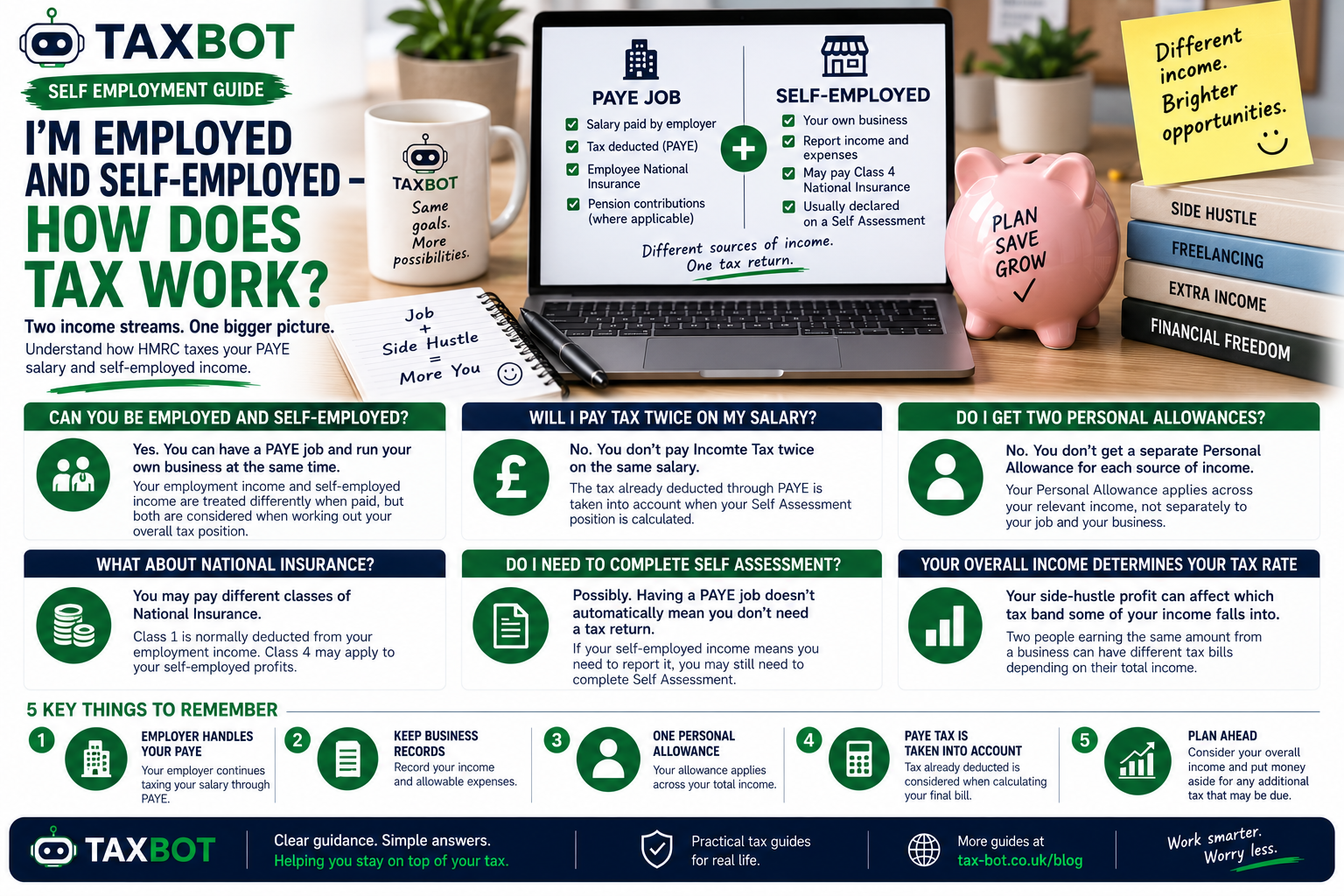
I’m Employed and Self-Employed – How Does Tax Work?
You have a normal job.
Your employer pays your salary and takes tax through PAYE.
But you've also started earning money for yourself.
Maybe you're freelancing in the evenings, tutoring at weekends, doing beauty treatments, selling products online, working on construction jobs or running a small business.
That leaves a very common question:
Can I be employed and self-employed at the same time — and how does the tax work?
Yes, you can.
And although having two types of income makes your tax look more complicated, the basic principle is actually quite straightforward.
Let's break it down.
Can You Be Employed and Self-Employed at the Same Time?
Yes.
You might work Monday to Friday for an employer and run your own business at weekends.
Or perhaps you have a part-time PAYE job while building a freelance business.
For tax purposes, you can therefore have:
Employment income
and
Self-employed income
during the same tax year.
They are treated differently when the money is paid to you, but both can ultimately affect your overall tax position.
What Happens to the Tax From My Normal Job?
Usually, nothing changes.
Your employer continues paying you through PAYE.
They normally deduct things such as:
Income Tax
Employee National Insurance
Pension contributions where applicable
Student loan deductions where applicable
before paying your net salary.
So if you earn £30,000 from your job, you don't suddenly need to personally pay all the tax on that £30,000 again just because you've become self-employed.
This brings us to one of the biggest worries people have.
Will I Pay Tax Twice on My PAYE Salary?
No — not simply because you complete a Self Assessment.
Your employment income may appear on your tax return because HMRC needs to understand your overall income for the year.
But the Income Tax you've already paid through PAYE is taken into account when your final tax position is calculated.
You aren't supposed to pay Income Tax twice on the same salary.
So Why Does HMRC Need to Know About My Salary?
Because your different sources of taxable income don't exist in completely separate tax worlds.
Your employment income can affect:
How much of your Personal Allowance remains
Which Income Tax band additional income falls into
Your overall tax calculation
That's why HMRC needs the bigger picture.
Do I Get Two Personal Allowances?
No.
This is an important one.
You don't normally receive:
one Personal Allowance for your PAYE job
PLUS
another Personal Allowance for your self-employed business.
Your Personal Allowance applies across your relevant income.
So imagine your salary already uses your Personal Allowance.
You then make additional taxable profit from your business.
You cannot simply assume another £12,570 of self-employed profit will automatically be tax-free.
Example: £30,000 Salary + £8,000 Self-Employed Profit
Imagine you earn:
PAYE salary: £30,000
and make:
Self-employed taxable profit: £8,000
Your combined income is broadly:
£38,000
before considering the detailed tax calculation and any other relevant income, deductions or adjustments.
Your employer has already been deducting Income Tax from your salary through PAYE.
When your Self Assessment position is calculated, the PAYE tax you've already paid is taken into account.
The calculation then determines what additional amount, if any, remains due.
Is My Self-Employed Tax Always 20%?
No.
This is where people can get caught out.
You can't simply say:
"I'm self-employed, so I'll pay 20% on my profit."
The rate of Income Tax that applies depends on your overall taxable income and circumstances.
For example, imagine your salary is already close to the point where some additional income falls into a higher tax band.
Your self-employed profit could push some of your total taxable income into that higher band.
So two people making exactly the same £10,000 self-employed profit could potentially have different tax bills.
Person A
Salary: £20,000
Self-employed profit: £10,000
Person B
Salary: £48,000
Self-employed profit: £10,000
They've both made £10,000 from their businesses.
But their overall income positions are very different.
What About National Insurance?
Employment and self-employment also have different National Insurance rules.
Your employer normally deducts Class 1 National Insurance from your employment earnings where applicable.
Separately, your self-employed profits may result in Class 4 National Insurance.
For the 2026/27 tax year, Class 4 National Insurance is generally charged at:
6% on relevant self-employed profits over £12,570 up to £50,270.
and
2% on relevant profits above £50,270.
So being employed doesn't automatically mean there can be no National Insurance associated with your self-employed work.
Does That Mean I'm Paying National Insurance Twice?
You may pay different classes of National Insurance because you have two different types of earnings.
That isn't simply the same contribution being charged twice.
Class 1 relates to employment.
Class 4 relates to relevant self-employed profits.
There are rules concerning people who have both types of income, and HMRC considers the relevant figures when determining what is due.
Do I Need to Complete Self Assessment?
Having a PAYE job doesn't automatically mean you don't need Self Assessment.
If your self-employed trading income means you need to report it, you may still need a tax return even though most of your income comes from employment.
This is particularly important for people who think:
"My employer sorts out my tax, so I don't need to do anything."
Your employer sorts out your PAYE payroll.
They aren't responsible for keeping the books or dealing with the tax obligations of your separate business.
What Goes on My Tax Return?
If you have employment and self-employment income, your Self Assessment can include information about both.
For your employment, you'll usually need information showing things such as:
Employment income
Income Tax already deducted
Your P60 can be particularly useful for checking these figures.
For your self-employed business, you'll need accurate records of things such as:
Business income
Allowable expenses
Taxable profit
Other relevant business information
This is why keeping proper records throughout the year is so important.
What If My Side Hustle Only Makes a Small Amount?
You may have heard about the £1,000 Trading Allowance.
If your qualifying gross trading income is £1,000 or less during the tax year, you may not need to tell HMRC about it, depending on your circumstances.
But remember:
£1,000 refers to gross trading income — not simply profit.
So if customers paid you £1,500 and you had £700 of expenses, don't assume you're below the threshold because your profit was only £800.
We cover this in more detail in our guide to earning over £1,000 from a side hustle.
What If I Earn £1,000 From More Than One Side Hustle?
Be careful.
You don't necessarily receive a completely separate £1,000 Trading Allowance for every little activity.
For example:
Tutoring: £700
Freelancing: £600
Relevant trading income: £1,300
Don't simply look at each activity individually and decide that both are under £1,000.
Do I Need to Tell My Employer I'm Self-Employed?
From a tax perspective, having a side business does not generally mean your employer starts managing its tax for you.
However, your employment contract may contain rules about second jobs, outside business interests, confidentiality or conflicts of interest.
That's an employment issue rather than simply a Self Assessment question.
So check your employment contract if you're unsure.
Will My Tax Code Change?
It can.
HMRC uses tax codes to tell employers how much Income Tax to deduct through PAYE.
Depending on your circumstances and the information HMRC holds, your tax code can change.
But don't assume that starting a business automatically means your employer will simply deduct all of your self-employed tax through your salary.
Keep preparing for your Self Assessment liability separately.
How Much Should I Put Aside for Tax?
There's no single percentage that works for everyone.
Someone with a £20,000 salary and £5,000 business profit has a very different overall tax position from someone with a £60,000 salary and £20,000 business profit.
Your tax provision needs to consider:
Your PAYE salary
Tax already deducted
Self-employed profit
Other income
Income Tax bands
National Insurance
Student loan repayments where relevant
Payments on account
Your individual circumstances
This is why simply putting aside "20%" without understanding your overall income can leave you short.
Don't Forget Payments on Account
This can cause another surprise.
If your Self Assessment liability reaches the relevant level, HMRC may require payments on account towards the following year's tax bill.
That can make your first substantial January payment considerably larger than expected.
So even if you've carefully saved for the tax on your side-business profit, don't forget to check whether payments on account could apply.
A Simple Example
Imagine you have:
PAYE salary: £35,000
Your employer deducts tax from that salary throughout the year.
You also make:
£12,000 taxable self-employed profit
When your tax position is calculated, HMRC considers your relevant income together.
The tax already deducted from your salary through PAYE is taken into account.
You then pay any additional amount calculated as due through Self Assessment.
The important point is:
Your £35,000 salary isn't simply taxed from scratch for a second time.
What Records Should I Keep?
For your PAYE employment, keep documents such as:
P60
P45 where relevant
Payslips
Tax code notices
For your business, keep:
Sales records
Invoices
Receipts
Expense records
Mileage records where relevant
Platform statements
Payment processor records
Bank records
Keeping everything organised throughout the year makes completing your tax return considerably easier.
Five Things to Remember
If you're employed and self-employed at the same time:
1. Your employer continues taxing your salary through PAYE.
2. Your self-employed business has its own record-keeping requirements.
3. You don't get a completely separate Personal Allowance for each source of income.
4. Tax already deducted through PAYE is taken into account when your overall tax position is calculated.
5. Your self-employed profit can affect which tax band some of your income falls into.
Frequently Asked Questions
Can I legally be employed and self-employed?
Yes. It's perfectly possible to have employment and run your own business at the same time.
Will HMRC tax my PAYE salary twice?
No. Income Tax already deducted through PAYE is taken into account when your Self Assessment position is calculated.
Does my employer pay the tax on my side hustle?
No. Your employer deals with your employment payroll. Your separate self-employed income remains your responsibility.
Do I get a £12,570 allowance for my job and another £12,570 for my business?
No. You don't normally get a separate Personal Allowance for every source of income.
Do I pay National Insurance on both?
You may pay Class 1 National Insurance through employment and Class 4 National Insurance on relevant self-employed profits.
Can my side hustle push me into the 40% tax band?
Potentially, yes. Your overall taxable income determines which Income Tax bands apply, not simply the size of your side hustle viewed in isolation.
My employer already takes tax every month. Why do I still owe HMRC?
Because the PAYE deductions relate primarily to your employment. If you have additional taxable income from self-employment, additional tax can still be due.
Final Thoughts
Being employed and self-employed at the same time isn't unusual.
The simplest way to think about it is:
Your employer deals with PAYE on your salary.
You deal with the records and tax responsibilities relating to your own business.
When HMRC works out your overall tax position, the different relevant sources of income are considered and the Income Tax you've already paid through PAYE is taken into account.
So don't worry that completing Self Assessment means HMRC simply taxes your entire salary for a second time.
Instead, concentrate on keeping accurate business records, understanding your profit and putting enough money aside for any additional tax that may eventually be due.
Disclaimer
This article is for general information purposes only and does not constitute tax, legal or financial advice. Tax rates, allowances and HMRC procedures can change, and individual circumstances vary. Always check current HMRC guidance or consult a qualified UK tax adviser or accountant for advice tailored to your circumstances.
Handle your MTD returns automatically
Snap receipts, log income, submit to HMRC — all from Telegram.
Try TaxBot →