Self Employment
I’ve Just Become Self-Employed – When Do I Pay Tax for the First Time?
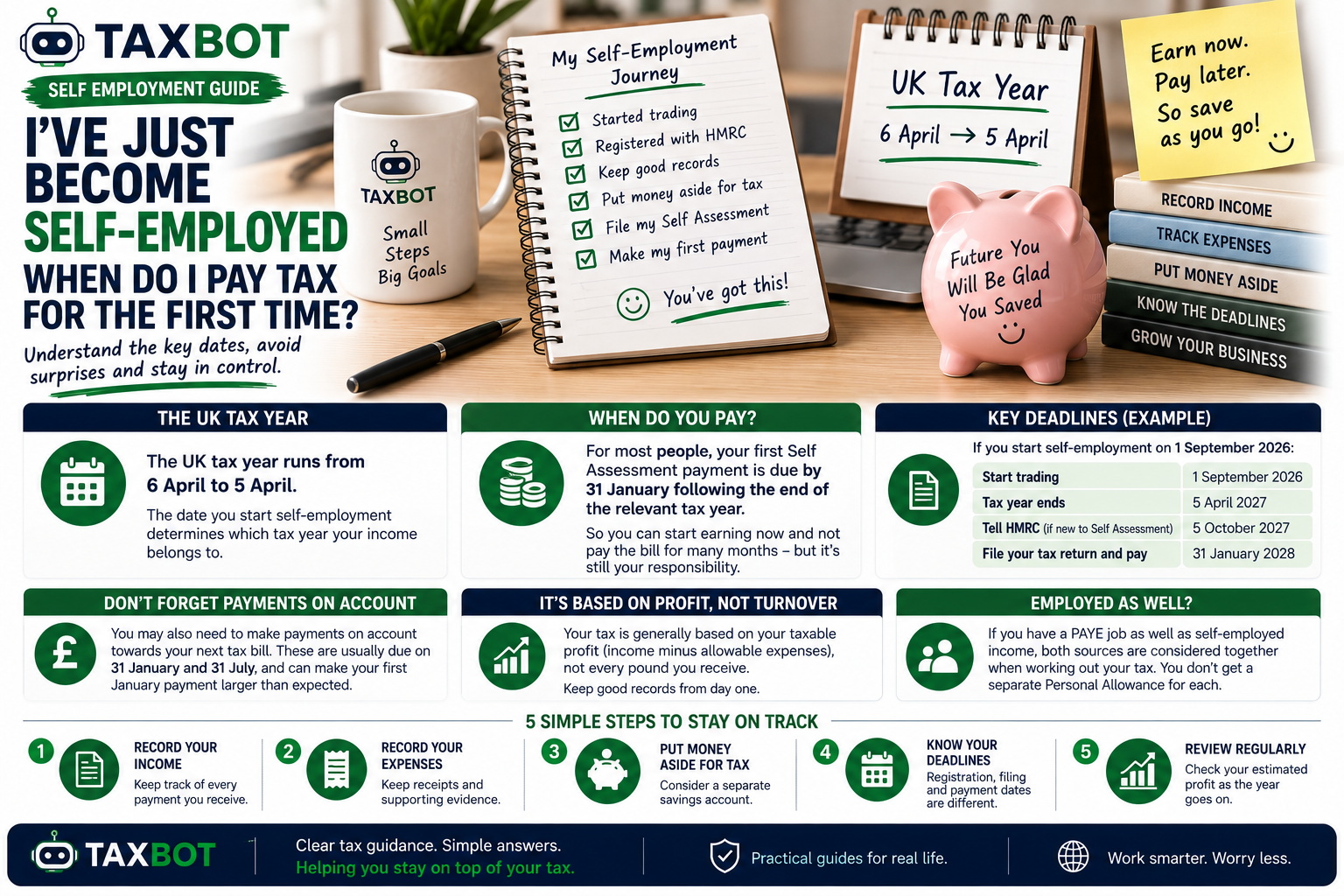
I’ve Just Become Self-Employed – When Do I Pay Tax for the First Time?
You've started working for yourself.
Money is coming in.
But nobody is deducting tax from your payments.
So when exactly do you pay HMRC?
Next month? At the end of the tax year? Next January?
For someone who's only ever been paid through PAYE, the system can feel surprisingly confusing.
The good news is that you normally don't pay Income Tax to HMRC every time a customer pays you.
Instead, your first Self Assessment bill can come many months after you start trading.
Here's how it works.
First, Understand the UK Tax Year
The UK tax year runs from:
6 April to 5 April
This matters because the date you start self-employment determines which tax return your first income belongs to.
For example, if you started self-employment on:
1 September 2026
your first period of self-employed income falls into the:
2026/27 tax year
which ends on:
5 April 2027
You'll then report the relevant income and expenses for that tax year.
So When Do I Actually Pay the Tax?
For most people completing Self Assessment online, the main payment deadline is 31 January following the end of the relevant tax year.
This creates a strange situation when you're newly self-employed.
You could start earning money in May and potentially not pay the resulting Self Assessment bill until the following January after that tax year has ended.
That's why it can feel like you're earning tax-free money for months.
You're not.
The bill simply hasn't become due yet.
Example: You Start Self-Employment in September 2026
Let's make this simple.
You start your business:
1 September 2026
You continue trading until:
5 April 2027
That income falls within the 2026/27 tax year.
You then complete the relevant Self Assessment tax return.
Your normal online filing and payment deadline would be:
31 January 2028
That means some of the money you earned in September 2026 might not result in a tax payment until January 2028.
This is exactly why saving for tax from the beginning is so important.
Do I Need to Register With HMRC Straight Away?
Don't confuse registering with paying.
They are two different things.
If you need to complete Self Assessment and haven't previously been required to file, you generally need to tell HMRC by 5 October following the end of the relevant tax year.
So, continuing our example:
Started trading: September 2026
Tax year ends: 5 April 2027
Registration deadline would normally be:
5 October 2027
Online tax return/payment deadline:
31 January 2028
Don't wait until January to think about registering.
What Happens If I Start Just Before 5 April?
This catches people out.
Imagine you start self-employment on:
20 March 2027
The tax year ends only a couple of weeks later on:
5 April 2027
Even though you've only been trading for a short period, that income still belongs to the 2026/27 tax year.
You don't simply wait and count it as part of the next tax year because you've only worked for two weeks.
The date you received or earned income and the accounting method you use can matter, so keep proper records from your first day of trading.
Do I Pay Tax on Everything Customers Pay Me?
Not necessarily.
There is an important difference between:
Turnover — the money your business receives
and
Taxable profit — broadly, your business income after relevant allowable deductions and adjustments.
Suppose your business receives:
£25,000
and you have:
£5,000 of allowable expenses
Your starting profit figure might broadly be:
£20,000
rather than £25,000.
Your actual tax calculation then depends on your overall circumstances.
What If I Also Have a PAYE Job?
This is extremely common.
You might have:
Salary: £30,000
and
Self-employed profit: £8,000
Your employer continues deducting tax from your salary through PAYE.
But that doesn't automatically settle the tax due on your self-employed income.
When completing Self Assessment, your other taxable income is also relevant to working out your overall tax position.
And remember:
You don't get a separate Personal Allowance for your job and another Personal Allowance for your business.
Your income needs to be considered together.
The Biggest First-Year Surprise: Payments on Account
This is something you should understand before your first January bill arrives.
HMRC may require you to make payments on account towards your next tax bill.
These are advance payments towards the following year's Self Assessment liability.
They're normally made twice:
31 January
and
31 July
And this can make your first January payment considerably larger than you expected.
Example: Your First Tax Bill Is £3,000
Imagine you've completed your first Self Assessment and your relevant tax bill is:
£3,000
You might naturally think:
"Great. I saved £3,000, so I'm covered."
But if payments on account apply, HMRC could also ask for the first advance payment towards the following year's bill.
Each payment on account would normally be half of the relevant previous year's bill.
So your January payment could potentially be:
£3,000 Your tax bill
PLUS
£1,500 First payment on account
TOTAL:
£4,500
Then another:
£1,500
could be due by 31 July.
HMRC's current rules say payments on account are generally required unless the relevant previous year's tax owed was less than £1,000 or more than 80% was already collected outside Self Assessment.
Am I Being Taxed Twice?
No.
This is probably the first thought many people have when they see the bill.
The extra £1,500 isn't another tax charge on the same income.
It's an advance payment towards your next tax bill.
When the next tax return is completed, HMRC takes those payments into account.
If you've paid too much, the difference can be refunded or credited.
If you've paid too little, you'll normally have a balancing payment to make.
What If My Business Earns Less Next Year?
If you genuinely expect your tax bill to be lower than the previous year, you may be able to ask HMRC to reduce your payments on account.
But be careful.
Don't reduce them simply because you'd rather keep the cash.
If you reduce them too far and your eventual tax bill turns out to be higher, HMRC can charge interest on the shortfall.
Should I Wait Until January to Work Out My Tax?
Definitely not.
January is the deadline, not the day you should start thinking about your tax return.
You can submit your Self Assessment earlier.
Doing it earlier has a major advantage:
you find out how much you owe sooner.
You could complete your return months before the payment deadline and then have time to budget for the bill.
How Much Should I Save?
There's no universal percentage because your tax position depends on things such as:
Your profit
Employment income
Other taxable income
Income Tax band
National Insurance
Allowances
Student loan repayments
Payments on account
Your individual circumstances
As discussed in our previous guide, some sole traders use a percentage of their income or estimated profit as a tax savings buffer.
The important thing is to start saving before HMRC asks for the money.
A Simple System for Your First Year
Every time your business gets paid:
1. Record the income
Don't rely entirely on your bank statement.
2. Record your expenses
Keep receipts and supporting records.
3. Put money aside for tax
Consider keeping your tax savings separate from everyday spending money.
4. Track your estimated profit
Don't wait until the tax year ends to find out whether you made £10,000 or £40,000.
5. Know your deadlines
Registration, filing and payment are different deadlines.
Common Questions
I've just become self-employed. Do I pay tax monthly?
Not normally through standard Self Assessment. Your tax is generally dealt with through the Self Assessment system, although you can choose to make payments towards your bill during the year.
Do I pay tax immediately after 5 April?
No. The end of the tax year doesn't mean the money immediately leaves your bank account.
Can I submit my tax return before January?
Yes. January is the online filing deadline, not the earliest date you can submit your return.
Why does my first tax bill seem so high?
Payments on account are one common reason. Your first January payment can include both the tax due for the year you've reported and an advance payment towards the next year.
Do I still need Self Assessment if I'm employed?
Potentially. Being employed through PAYE doesn't automatically remove your responsibility to report separate self-employed income.
What happens if I can't afford my tax bill?
Don't simply ignore it. HMRC may offer payment arrangements in some circumstances. Late tax can attract interest and potentially penalties, so deal with the problem as early as possible.
Final Thoughts
The strange thing about your first year of self-employment is that HMRC may not ask you for the tax for quite a long time.
That can make your bank balance look healthier than it really is.
Don't mistake:
"HMRC hasn't asked me for the money yet"
for:
"I don't owe any tax."
From your first month of self-employment, keep proper records and start putting money aside.
And before your first Self Assessment bill arrives, understand payments on account.
That one bit of preparation can prevent a very unpleasant surprise in January.
Disclaimer
This article is for general information purposes only and does not constitute tax, legal or financial advice. Tax rules, thresholds and HMRC procedures can change and individual circumstances vary. Always check current HMRC guidance or consult a qualified UK tax adviser or accountant for advice tailored to your circumstances.
Handle your MTD returns automatically
Snap receipts, log income, submit to HMRC — all from Telegram.
Try TaxBot →