Self Employment
What Are Payments on Account and Why Has HMRC Asked Me to Pay Twice?
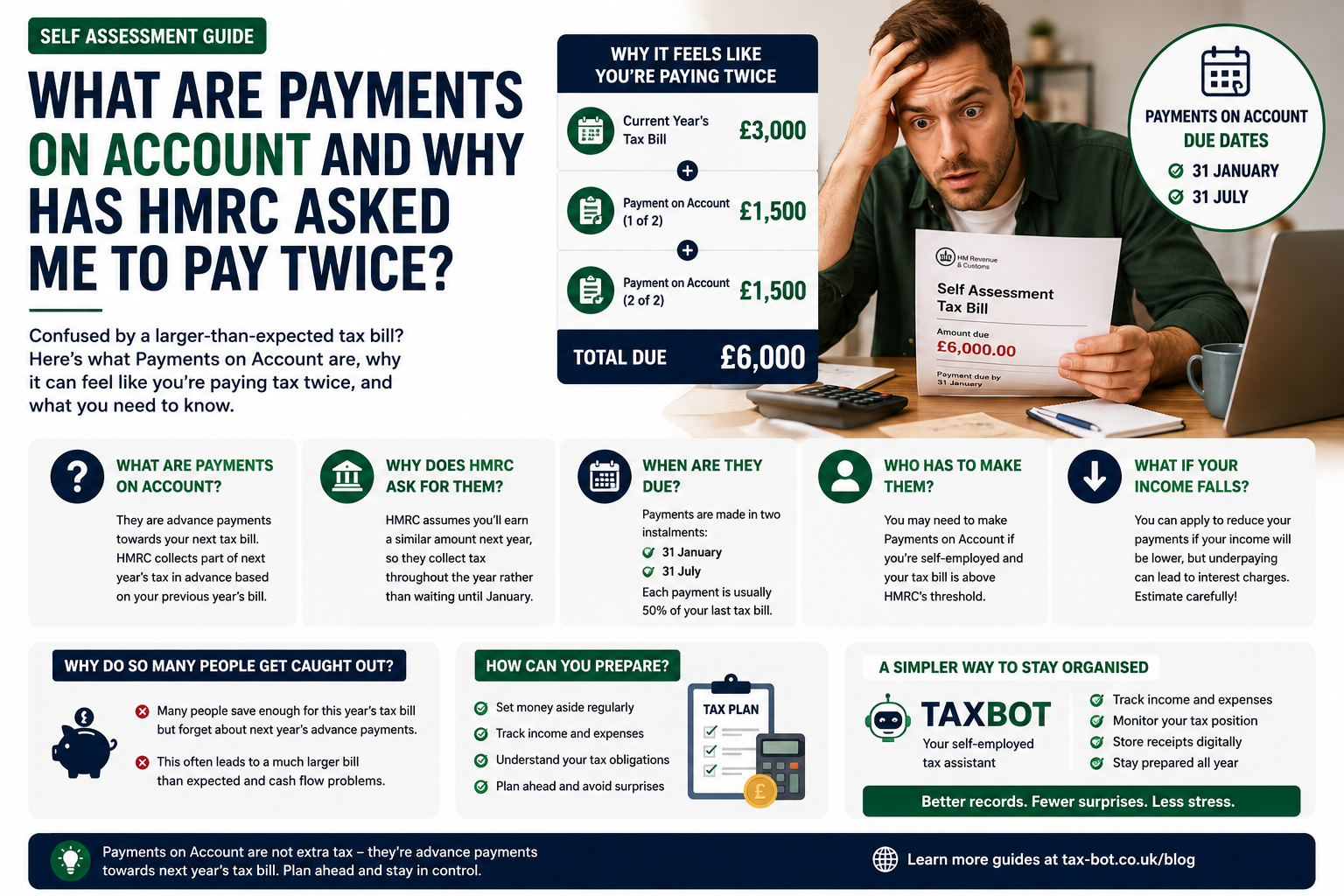
What Are Payments on Account and Why Has HMRC Asked Me to Pay Twice?
One of the biggest shocks for newly self-employed people is receiving a Self Assessment tax bill that is much higher than expected.
Many people look at their HMRC account and immediately ask:
👉 Why am I being asked to pay tax twice?
The answer is usually something called Payments on Account.
If you've never encountered them before, they can be confusing — and expensive if you're not prepared.
What Are Payments on Account?
Payments on Account are advance payments towards your next tax bill.
HMRC uses them to collect tax throughout the year from self-employed individuals and others who complete a Self Assessment tax return.
Rather than waiting until the following January, HMRC asks many taxpayers to make payments in advance based on their previous tax bill.
Why Does HMRC Ask for Them?
HMRC assumes that if you earned a certain amount this year, you may earn a similar amount next year.
As a result, they ask for part of next year's estimated tax bill before it becomes due.
For many taxpayers, this helps spread payments throughout the year.
However, for people seeing it for the first time, it can come as a major surprise.
Why Does It Feel Like You're Paying Tax Twice?
This is where most confusion happens.
Imagine your tax bill for the year is:
£3,000
HMRC may ask you to pay:
£3,000 for the tax year that has just ended
£1,500 as your first Payment on Account
£1,500 as your second Payment on Account
Total due:
👉 £6,000
Many people assume HMRC has made a mistake.
In reality, half of that amount is being collected in advance towards the following tax year.
When Are Payments on Account Due?
Payments are usually made in two instalments:
First Payment
31 January
Second Payment
31 July
Each payment is normally 50% of the previous year's tax bill.
Who Has to Make Payments on Account?
You may need to make Payments on Account if:
You're self-employed
You complete a Self Assessment tax return
Your tax bill exceeds certain HMRC thresholds
Many freelancers, consultants, landlords and CIS subcontractors are affected.
What Happens If Your Income Falls?
If you expect your income to be lower than the previous year, you may be able to apply to reduce your Payments on Account.
However, reducing them incorrectly can lead to interest charges if you underpay.
It's important to estimate carefully.
Why Do So Many People Get Caught Out?
The biggest issue is cash flow planning.
Many people save enough for:
✅ This year's tax bill
But forget about:
❌ Next year's advance payments
The result is often a much larger bill than expected.
How Can You Prepare?
The best approach is:
Set money aside regularly
Track income and expenses throughout the year
Understand your upcoming tax obligations
Avoid leaving tax planning until January
Good record keeping makes forecasting much easier.
A Simpler Way to Stay Organised
With TaxBot, you can:
Track income and expenses
Monitor your tax position
Store receipts digitally
Stay prepared for Self Assessment deadlines
The better your records, the fewer surprises you'll face when your tax bill arrives.
Final Thoughts
Payments on Account are not an additional tax.
They're advance payments towards future tax liabilities.
Understanding how they work can help you avoid one of the biggest surprises self-employed people face.
👉 If you're self-employed, planning ahead is often the difference between a manageable tax bill and a stressful one.
Disclaimer
This article is for general information purposes only and does not constitute tax, legal, or financial advice. Tax rules can change and individual circumstances vary. Always consult a qualified UK tax adviser or accountant for advice tailored to your situation.
Handle your MTD returns automatically
Snap receipts, log income, submit to HMRC — all from Telegram.
Try TaxBot →