HMRC Guides
What Does BR Tax Code Mean? (And Are You Paying Too Much Tax?)
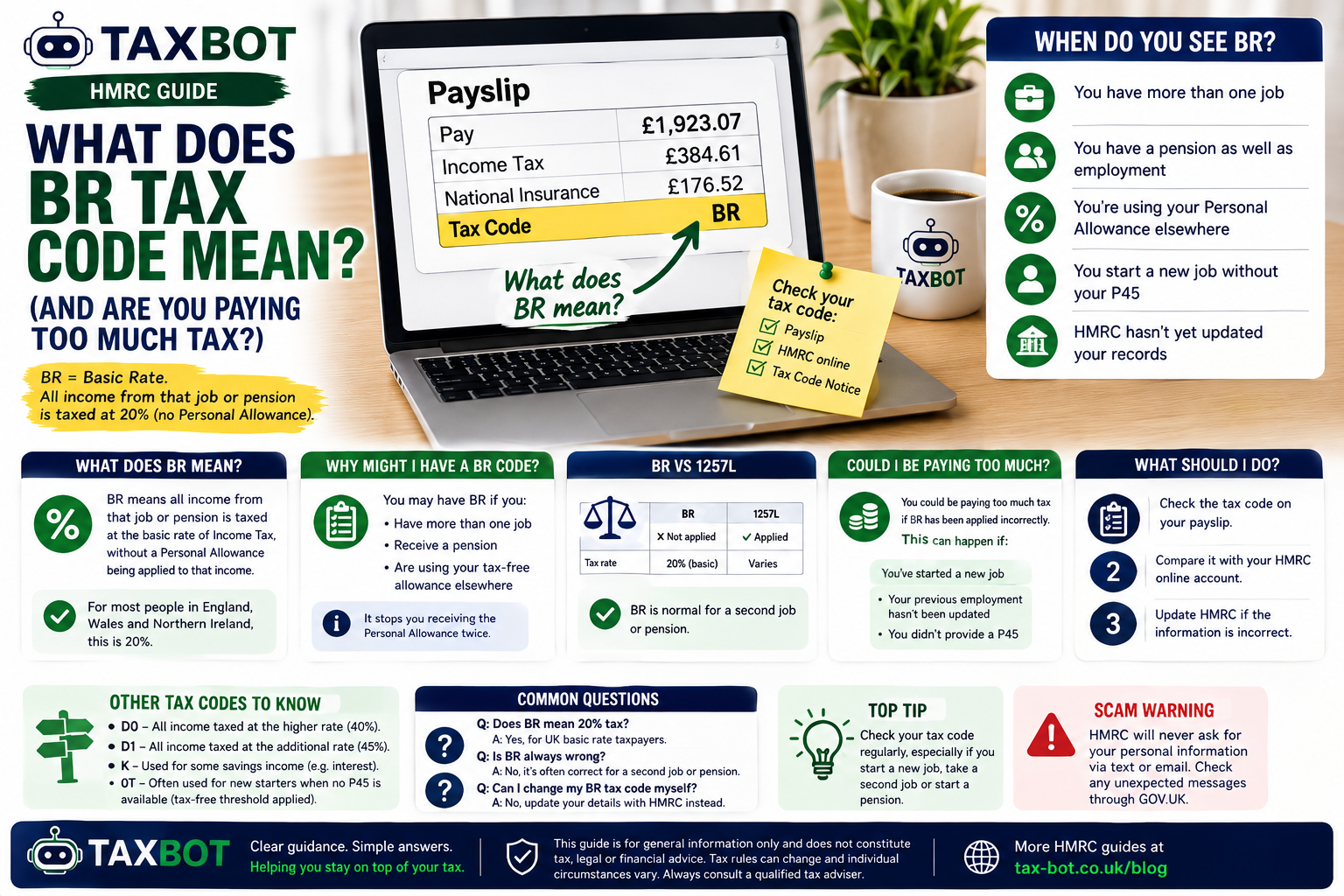
What Does BR Tax Code Mean?
Have you checked your payslip and noticed that your tax code says BR instead of something like 1257L?
You may immediately wonder:
What does BR tax code mean?
Why am I on BR?
Am I paying too much tax?
BR stands for Basic Rate.
It means that all the income from that particular job or pension is being taxed at the basic rate of Income Tax, without a Personal Allowance being applied to that income.
Here's how it works.
What Is a BR Tax Code?
The BR tax code tells your employer or pension provider to deduct Income Tax at the basic rate from all of the income from that job or pension.
For taxpayers in England, Wales and Northern Ireland, the basic Income Tax rate is currently 20%.
So, if BR is being used for a job, tax is generally deducted at 20% from the taxable pay from that employment.
Why Have I Been Given a BR Tax Code?
A BR tax code is commonly used when you have more than one job or pension.
You only have one Personal Allowance for the tax year.
For example, your main job might use your Personal Allowance through a tax code such as:
1257L
while your second job could use:
BR
This prevents the same Personal Allowance being applied twice.
Does BR Mean I'm on Emergency Tax?
Not necessarily.
Seeing BR on your payslip does not automatically mean you're on an emergency tax code.
BR is a tax code in its own right.
However, BR can sometimes appear when you start a new job and HMRC or your employer does not yet have the correct information about your circumstances.
This is one reason it's worth checking the code rather than assuming it's correct.
Could I Be Paying Too Much Tax on BR?
Possibly.
A BR tax code may be perfectly correct if, for example, your Personal Allowance is already being used against income from another job.
But if BR has been applied incorrectly, you could potentially pay more tax than necessary.
This can sometimes happen when:
You start a new job
Your previous employment has not been updated
You did not provide a P45
Starter information was missing or incorrect
HMRC's information about your employment has not yet been updated
Example: BR Tax Code on a Second Job
Imagine you have two jobs.
Your main job uses your Personal Allowance.
Your second job pays you £500 in taxable income during a month.
If that second job uses BR and the applicable basic rate is 20%, £100 of Income Tax would generally be deducted from that £500.
Your exact overall tax position still depends on your total income and circumstances.
BR vs 1257L — What's the Difference?
For many people with one job, 1257L is the standard tax code.
It normally gives the employer a tax-free amount based on the standard Personal Allowance.
BR works differently.
With BR:
No Personal Allowance is applied to that source of income, and all of the income is taxed at the basic rate.
That's why seeing BR unexpectedly on your main job is worth investigating.
What If BR Is on My Main Job?
Don't automatically assume it's wrong, but check it.
HMRC may have information about other income that explains why BR has been applied.
You can check your tax code through:
Your payslip
Your HMRC online account
The HMRC app
A Tax Code Notice from HMRC
Compare the tax code on your payslip with the code HMRC currently holds for that employment.
What If My BR Tax Code Is Wrong?
If you believe BR does not reflect your circumstances, check the information HMRC holds about your employment.
For example, an old job might still appear active when you've already left.
HMRC provides online services where you can check your Income Tax information and tax code.
If HMRC changes your tax code, your employer will normally receive the updated code and use it through payroll.
Will I Get Overpaid Tax Back?
If you've paid too much Income Tax because your tax code was incorrect, you may be entitled to have the overpayment corrected.
Depending on the circumstances and when the code is corrected, this may happen through your pay or through HMRC's tax reconciliation process.
What Does CBR Mean?
If your main home is in Wales, you may see CBR rather than BR.
CBR means all income from that job or pension is taxed at the Welsh basic rate.
Scottish taxpayers have different tax codes and Income Tax rates.
BR vs D0 vs D1
These codes can often appear where someone has more than one source of PAYE income.
BR — all income from that job or pension is taxed at the basic rate.
D0 — all income from that job or pension is taxed at the higher rate.
D1 — all income from that job or pension is taxed at the additional rate.
Which code is appropriate depends on your overall income and circumstances.
Common Questions About BR Tax Codes
Does BR mean 20% tax?
For taxpayers subject to the main UK Income Tax rates, BR means all income from that particular job or pension is taxed at the basic rate, currently 20%.
Is BR always wrong?
No.
BR is commonly correct for a second job or pension where your Personal Allowance is being used elsewhere.
Why have I suddenly changed to BR?
Your tax code can change when HMRC receives new information about your employment, pension or other income.
If the change is unexpected, check your HMRC account and payslip.
Should my second job be BR?
It may be. BR is commonly used for second jobs, but the correct code depends on your total income and individual circumstances.
Can I change my BR tax code myself?
You cannot simply choose the tax code your employer uses. If the information HMRC holds is incorrect, update it or contact HMRC so the correct tax code can be determined.
Final Thoughts
Seeing BR on your payslip doesn't automatically mean something has gone wrong.
For many people with a second job or pension, it's completely normal.
But if BR suddenly appears on your main employment—or doesn't seem to fit your circumstances—it's worth checking.
Check the tax code on your payslip against the information HMRC holds for you.
Spotting an incorrect tax code early could prevent months of incorrect tax deductions.
Disclaimer
This article is for general information purposes only and does not constitute tax, legal or financial advice. Tax rates, allowances and HMRC rules can change, and individual circumstances vary. Always check current GOV.UK guidance or consult a qualified UK tax adviser or accountant for advice tailored to your situation.
Handle your MTD returns automatically
Snap receipts, log income, submit to HMRC — all from Telegram.
Try TaxBot →