HMRC Guides
What Is a P800 Tax Calculation? (Will You Get a Tax Refund or Owe HMRC Money?)
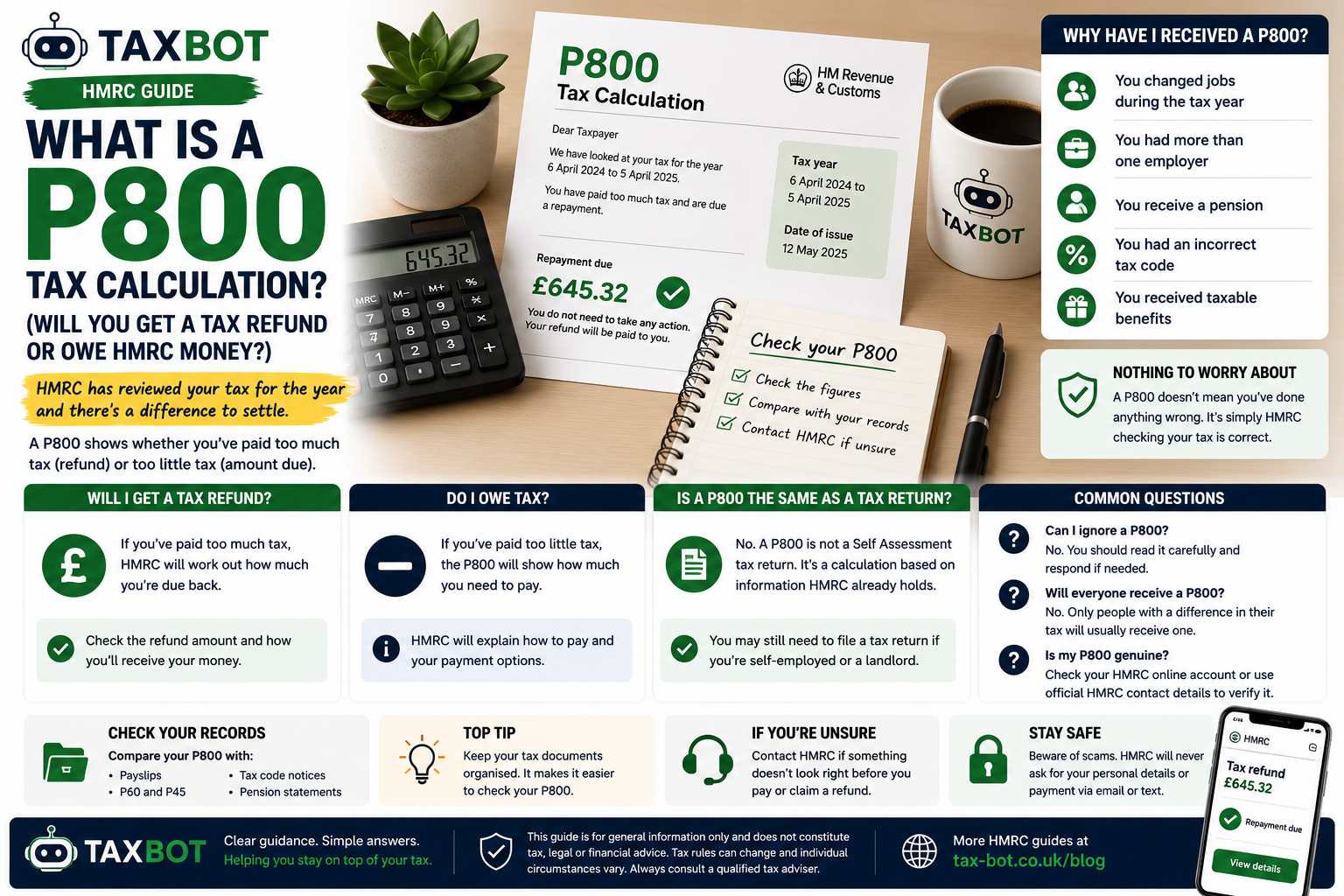
What Is a P800 Tax Calculation? (Will You Get a Tax Refund or Owe HMRC Money?)
Receiving a letter from HMRC can be worrying—especially if it's something you've never seen before.
One document that often causes confusion is the P800 Tax Calculation.
Many people immediately wonder:
👉 What is a P800?
👉 Am I getting a tax refund?
👉 Do I owe HMRC money?
Here's what you need to know.
What Is a P800?
A P800 Tax Calculation is a letter from HMRC that explains you've paid either:
Too much Income Tax
Too little Income Tax
during a tax year.
HMRC uses information from employers, pension providers and other sources to work out whether the correct amount of tax has been paid.
Why Have I Received a P800?
There are several reasons why HMRC may send a P800.
Common examples include:
Changing jobs during the tax year
Having more than one employer
Receiving a pension
An incorrect tax code
Changes to taxable benefits
Receiving a P800 does not automatically mean you've done anything wrong.
Does a P800 Mean I'll Get a Tax Refund?
Sometimes.
If HMRC calculates that you've paid too much tax, the P800 will explain:
How much you're due
How the refund can usually be claimed
Always read the letter carefully and follow the official HMRC instructions.
What If I Owe Tax?
A P800 can also show that you've paid too little tax.
If this happens, HMRC will explain:
How much is owed
How payment can normally be made
Whether the tax can be collected through your tax code or another method
The process depends on your individual circumstances.
Is a P800 the Same as a Tax Return?
No.
A P800 is not a Self Assessment tax return.
It's a tax calculation prepared by HMRC using information they already hold.
How Can I Check If My P800 Is Correct?
Before taking any action, it's sensible to compare the information shown with your own records.
Check:
Payslips
Your P60
Your P45 (if you changed jobs)
Tax code notices
Pension statements (if applicable)
If something doesn't look right, contact HMRC before making any payment or claiming a refund.
Common Questions
Can I Ignore a P800?
No.
If HMRC has contacted you, you should read the letter carefully and respond if necessary.
Ignoring tax correspondence could lead to further action.
Will Everyone Receive a P800?
No.
Only taxpayers whose records show a possible difference between the tax paid and the tax due will normally receive one.
Is a P800 Genuine?
Unfortunately, scammers sometimes send fake HMRC emails or text messages.
If you're unsure whether a P800 is genuine, use the official HMRC contact details or your HMRC online account to verify it.
Never click suspicious links or provide personal information in response to unexpected messages.
Keep Your Tax Records Organised
Keeping records such as:
Payslips
P60s
P45s
HMRC letters
Tax code notices
can make it much easier to understand any calculations sent by HMRC.
Final Thoughts
Receiving a P800 can be surprising, but it doesn't necessarily mean there's a problem.
It simply means HMRC has reviewed the information available and believes your tax position needs adjusting.
Checking the details carefully and keeping good records can help you resolve any issues quickly and confidently.
Disclaimer
This article is for general information purposes only and does not constitute tax, legal or financial advice. Tax rules can change and individual circumstances vary. Always consult a qualified UK tax adviser or accountant for advice tailored to your situation.
Handle your MTD returns automatically
Snap receipts, log income, submit to HMRC — all from Telegram.
Try TaxBot →