HMRC Guides
What Is an HMRC Starter Checklist? (What to Do If You Don't Have a P45)
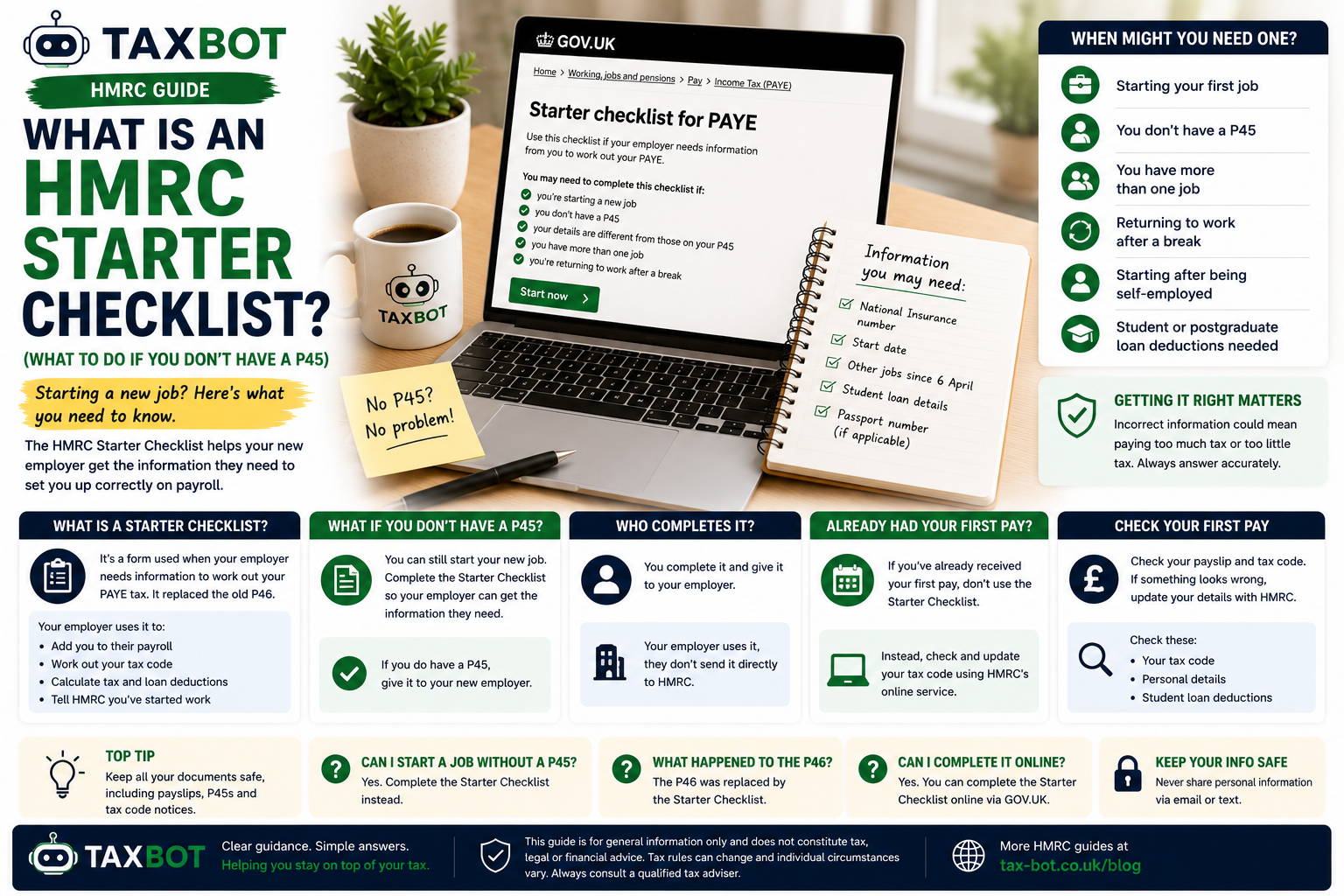
What Is an HMRC Starter Checklist?
Starting a new job and been asked to complete an HMRC Starter Checklist?
You might be wondering:
What is a Starter Checklist?
Why does my employer need it?
What happens if I don't have a P45?
The Starter Checklist gives your new employer information they need to set you up correctly on payroll and work out how much tax should be deducted from your first pay.
Here's how it works.
What Is an HMRC Starter Checklist?
The HMRC Starter Checklist is a form used when you're starting a new job and your employer needs information to work out your PAYE tax.
It's particularly important if you do not have a P45 from a previous employer.
The Starter Checklist replaced the old P46 form.
Your employer uses the information you provide to:
Add you to their payroll
Work out the tax code to use for your first pay
Calculate how much tax to deduct
Work out any student or postgraduate loan deductions
Tell HMRC you've started working for them
Who Needs to Complete a Starter Checklist?
You may be asked to complete one if:
You're starting your first job
You're starting your first job in the UK
You don't have a P45
Your details are different from those on your P45
You're returning to work after a break
You're starting employment after being self-employed
You have more than one job
Your employer needs information about your student or postgraduate loan
Your employer may sometimes ask you to complete the checklist even if you've provided a P45.
What If I Don't Have a P45?
Don't panic.
Not having a P45 does not prevent you from starting a new job.
Instead, your employer can use the Starter Checklist to collect the information needed to work out your initial tax position.
If you do have a P45, you should normally give it to your new employer.
What Information Will You Need?
Before completing the checklist, you may need information including:
Your National Insurance number
Your new job's start date
Whether you've had another job or pension since 6 April
Whether you've received certain benefits since 6 April
Details of any student or postgraduate loan
Your passport number in certain circumstances if you've been sent to work temporarily in the UK
It's worth gathering everything before starting the online form.
Why Is Completing It Correctly Important?
The answers you give help determine how your employer initially deals with your PAYE tax.
If incorrect information is provided, you could end up:
paying too much tax
or
paying too little tax.
That's why you shouldn't simply guess when completing the checklist.
What Happens After You Complete It?
You give the completed Starter Checklist to your employer, rather than sending it separately to HMRC yourself.
Your employer uses the information to set you up on payroll and report your employment information to HMRC.
Is a Starter Checklist the Same as a P46?
Essentially, the Starter Checklist replaced the old P46 process.
You may still hear people refer to a "P46", particularly when starting a new job without a P45.
However, the P46 is no longer the form used for this purpose.
I've Already Received My First Pay — Should I Complete One?
HMRC says that if you've already received your first pay, you should not use the Starter Checklist.
Instead, you can use HMRC's online Income Tax service to check your tax code and update incorrect details.
Can the Starter Checklist Affect My Tax Code?
Yes.
The information provided helps your employer determine the appropriate tax treatment for your first pay.
This is one reason it's important to answer the questions accurately.
If your first payslip shows an unexpected amount of tax, check the tax code shown on the payslip.
What If My Tax Code Looks Wrong?
If something doesn't look right:
Check your first payslip.
Check your tax code.
Compare the information with your HMRC records.
Update HMRC if your employment information is incorrect.
Don't assume an unexpectedly high deduction will automatically sort itself out.
Starter Checklist vs P45: What's the Difference?
A P45 comes from your previous employer when you leave a job and contains information about your pay and tax.
A Starter Checklist provides information to your new employer when they cannot rely on a suitable P45 or need additional information.
Both can help your new employer determine how your pay should initially be taxed.
Common Questions
Can I start a job without a P45?
Yes.
If you don't have a P45, you can normally complete the HMRC Starter Checklist instead.
Do I send the Starter Checklist to HMRC?
Normally, no.
You provide it to your new employer.
What happened to the P46?
The P46 was replaced by the Starter Checklist.
Can I complete the Starter Checklist online?
Yes. HMRC provides an online Starter Checklist through GOV.UK.
What if I complete it incorrectly?
Incorrect information could result in the wrong amount of tax being deducted. Check your first payslip and tax code, and correct any inaccurate information promptly.
Final Thoughts
If you're starting a new job without a P45, the HMRC Starter Checklist is an important part of getting your payroll set up correctly.
It helps your employer understand your employment and tax circumstances so they can determine the appropriate tax treatment for your first pay.
The most important thing is simple:
Complete it accurately and check your first payslip afterwards.
Catching an incorrect tax code early can save a lot of confusion later.
Disclaimer
This article is for general information purposes only and does not constitute tax, legal or financial advice. Tax rules and HMRC procedures can change, and individual circumstances vary. Always check current GOV.UK guidance or consult a qualified UK tax adviser or accountant for advice tailored to your situation.
Handle your MTD returns automatically
Snap receipts, log income, submit to HMRC — all from Telegram.
Try TaxBot →