Self Employment
When Do I Pay Tax for the First Time After Becoming Self-Employed?
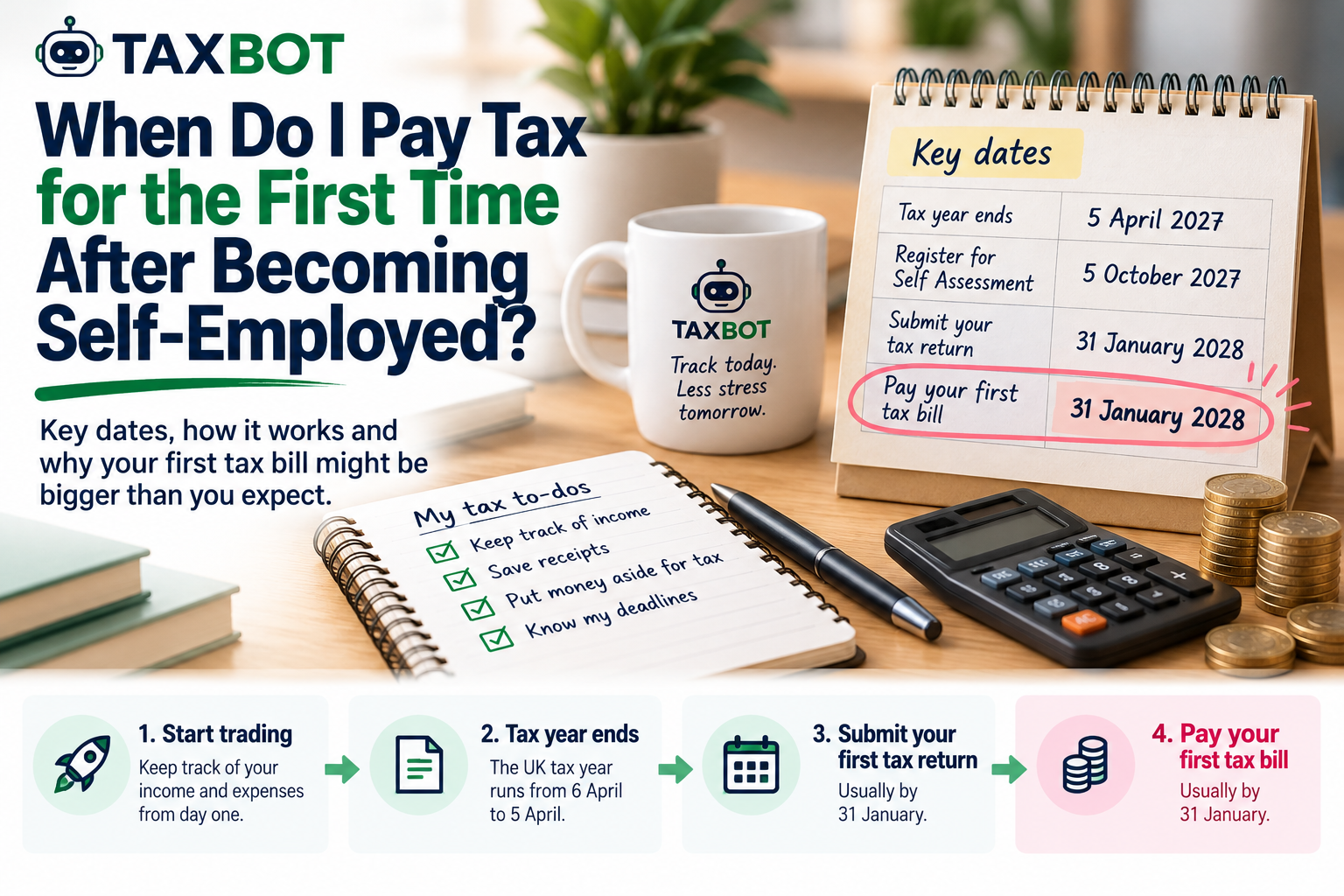
When Do I Pay Tax for the First Time After Becoming Self-Employed?
Starting your own business or earning money from freelance work is exciting. But once the money starts coming in, there's one question that often causes confusion: when do I actually have to pay tax to HMRC?
If you've recently become self-employed, you might be surprised to learn that you don't usually pay Income Tax every month as you would through a regular job.
Instead, most sole traders report their earnings through Self Assessment and pay their tax after the tax year has ended.
The important thing is understanding when your first payment is due, because your first tax bill could be bigger than you expect.
Here's how it works.
Do You Pay Tax Straight Away When You Become Self-Employed?
Usually, no.
If you're self-employed as a sole trader, you don't normally have Income Tax automatically deducted every time a customer pays you.
Instead, you keep track of your business income and expenses throughout the tax year. You then report your taxable profits to HMRC, usually through a Self Assessment tax return.
Your tax bill is calculated based on your circumstances, including your profits, other income, allowances and any National Insurance contributions due.
This means you could be earning money for several months before making your first Self Assessment payment.
But that doesn't mean the money is all yours to spend.
It's sensible to start putting money aside for tax from the beginning.
When Is Your First Self-Employed Tax Payment Due?
For most newly self-employed sole traders, the first Self Assessment tax payment is due on 31 January following the end of the tax year in which they started trading.
The UK tax year runs from 6 April to 5 April.
For example, if you start working for yourself in October 2026, your first tax year will end on 5 April 2027.
Your usual deadlines would be:
What you need to do
Deadline
Start self-employment
October 2026
Tax year ends
5 April 2027
Register for Self Assessment, if required
5 October 2027
Submit your first online tax return
31 January 2028
Pay your first Self Assessment tax bill
31 January 2028
That's more than a year after you started your business.
It can feel like a long time, but remember that you're building up a tax liability while you work.
These are the standard Self Assessment deadlines. Different arrangements can apply if HMRC issues a late notice to file, and some taxpayers fall within Making Tax Digital for Income Tax.
What If You Started Self-Employment in 2025?
If you started trading between 6 April 2025 and 5 April 2026, your first tax payment will normally be due by 31 January 2027.
If you need to register for Self Assessment and haven't done so already, the standard registration deadline was 5 October 2026.
If you've missed that date, don't ignore the situation. Register or contact HMRC as soon as possible.
Registering late can lead to penalties, and it doesn't automatically extend your payment deadline.
Why Is the First Self-Employed Tax Bill Sometimes So High?
This is where many people get caught out.
When you complete your first Self Assessment return, HMRC may ask you to pay more than just the tax you owe for the year you've finished.
You may also need to make an advance payment towards your next tax bill.
These advance payments are called payments on account.
An Example: Your First Tax Bill Is £3,000
Imagine you've completed your first tax return and your relevant Income Tax and National Insurance bill is £3,000.
If payments on account apply, your payments could look like this:
Payment
Amount
Tax owed for the completed tax year
£3,000
First payment on account for the following year
£1,500
Total due by 31 January
£4,500
Second payment on account due 31 July
£1,500
Suddenly, what you thought was a £3,000 bill becomes a £4,500 payment in January.
The additional £1,500 isn't an extra tax charge. It's an advance payment towards your next year's liability.
Not everyone needs to make payments on account. Generally, they aren't required if the relevant previous year's tax bill was less than £1,000 or more than 80% of the tax was collected outside Self Assessment.
What If You Only Earned a Small Amount?
Becoming self-employed doesn't automatically mean you'll owe Income Tax.
For example, you might start a small business and earn £4,000 in sales during your first year, with £1,500 in allowable expenses.
That leaves a profit of £2,500.
If you have no other taxable income, you may not owe Income Tax because your total income could be below your available Personal Allowance.
However, if you also have a full-time job, your employment income may already use up your Personal Allowance.
In that situation, your self-employed profit could create an additional tax bill.
It's also important to distinguish between owing tax and needing to report your income. A sole trader with more than £1,000 in gross trading income will normally need to consider Self Assessment registration, even if their final tax bill is zero.
Do You Have to Pay National Insurance Too?
Depending on your profits and circumstances, you may need to pay Class 4 National Insurance as well as Income Tax.
Class 4 National Insurance is normally calculated through Self Assessment, rather than being deducted every time a customer pays you.
The amount depends on your self-employed profits and the thresholds applying to the relevant tax year.
This is another reason to budget for more than just Income Tax.
Can You Pay HMRC Monthly Instead?
Yes, you can make regular payments towards your future Self Assessment bill rather than waiting until January.
HMRC offers ways to make advance payments, including regular budgeting arrangements.
You can also put money into a separate savings account and pay HMRC when your bill becomes due.
For many self-employed people, transferring a percentage of each payment received into a dedicated tax savings account is one of the simplest habits to develop.
For example, you might decide to set aside 25% to 30% of your profit as an initial budgeting guide.
That isn't an official HMRC rate, and it won't be enough for everyone. The right amount depends on your total income, tax bands, National Insurance and other circumstances.
What Happens If You Can't Afford Your First Tax Bill?
If you reach your payment deadline and realise you can't afford the amount owed, don't ignore HMRC.
Depending on your circumstances, you may be eligible for a Time to Pay arrangement, which allows you to pay your debt in instalments.
HMRC will consider factors such as how much you owe and your ability to make repayments.
Interest may still apply to outstanding tax.
It's much better to contact HMRC early than to leave the bill unpaid without making arrangements.
Can You Reduce Payments on Account If Your Income Falls?
Possibly.
Payments on account are usually based on your previous year's tax liability.
But what if you had a very successful first year and expect to earn significantly less in your second year?
You may be able to apply to reduce your payments on account.
However, be careful. If you reduce them too much and your actual tax liability turns out to be higher, HMRC can charge interest on the shortfall.
Only request a reduction when you have a reasonable basis for expecting a lower bill.
How Can You Prepare for Your First Tax Payment?
The best time to prepare is when you first start earning.
Keep a record of the money customers pay you and the expenses you incur. Save invoices and receipts, and regularly check how much profit your business is making.
You don't need to wait until January to calculate an estimate of what you might owe.
Completing your tax return soon after the tax year ends can give you several months to prepare for the payment deadline.
And remember that tax is generally calculated on your taxable business profit, not simply the total amount customers have paid you.
Frequently Asked Questions
If I Start Self-Employment in January, When Do I Pay Tax?
If you start in January 2027, your first tax year will end on 5 April 2027. Your first Self Assessment tax payment would normally be due by 31 January 2028.
Do I Pay Tax in My First Year of Self-Employment?
You may owe tax on your first year's profits, but the payment usually becomes due after the tax year has ended.
What If I Have a Full-Time Job as Well?
You may still need to report your self-employed earnings. Your employment income and self-employed profits are taken into account when calculating your overall Income Tax liability.
What If I Make No Profit?
If your business makes no taxable profit, you may not owe Income Tax on that activity. However, you may still have reporting obligations, particularly if you're registered for Self Assessment or HMRC has asked you to submit a return.
Do I Need an Accountant for My First Tax Return?
Not necessarily. Many sole traders complete their own tax returns. However, an accountant can be helpful if you have multiple sources of income, complicated expenses or uncertainty about what you owe.
Final Thoughts
Starting self-employment means taking responsibility for tax that an employer would normally deduct for you.
The biggest mistake isn't necessarily calculating your tax incorrectly. It's reaching your first January payment deadline without having saved enough money.
Understanding your tax year, keeping accurate records and planning for payments on account can make your first Self Assessment much less stressful.
The sooner you understand when your tax is due, the easier it becomes to manage your business finances with confidence.
Disclaimer: This article is for general information purposes only and does not constitute tax, legal or financial advice. Tax rules can change and individual circumstances vary. Always check current HMRC guidance or consult a qualified UK tax adviser or accountant for advice tailored to your situation.
Handle your MTD returns automatically
Snap receipts, log income, submit to HMRC — all from Telegram.
Try TaxBot →