CIS / Construction
Why Is CIS Taking 30% From My Pay? (And How Do I Get It Changed?)
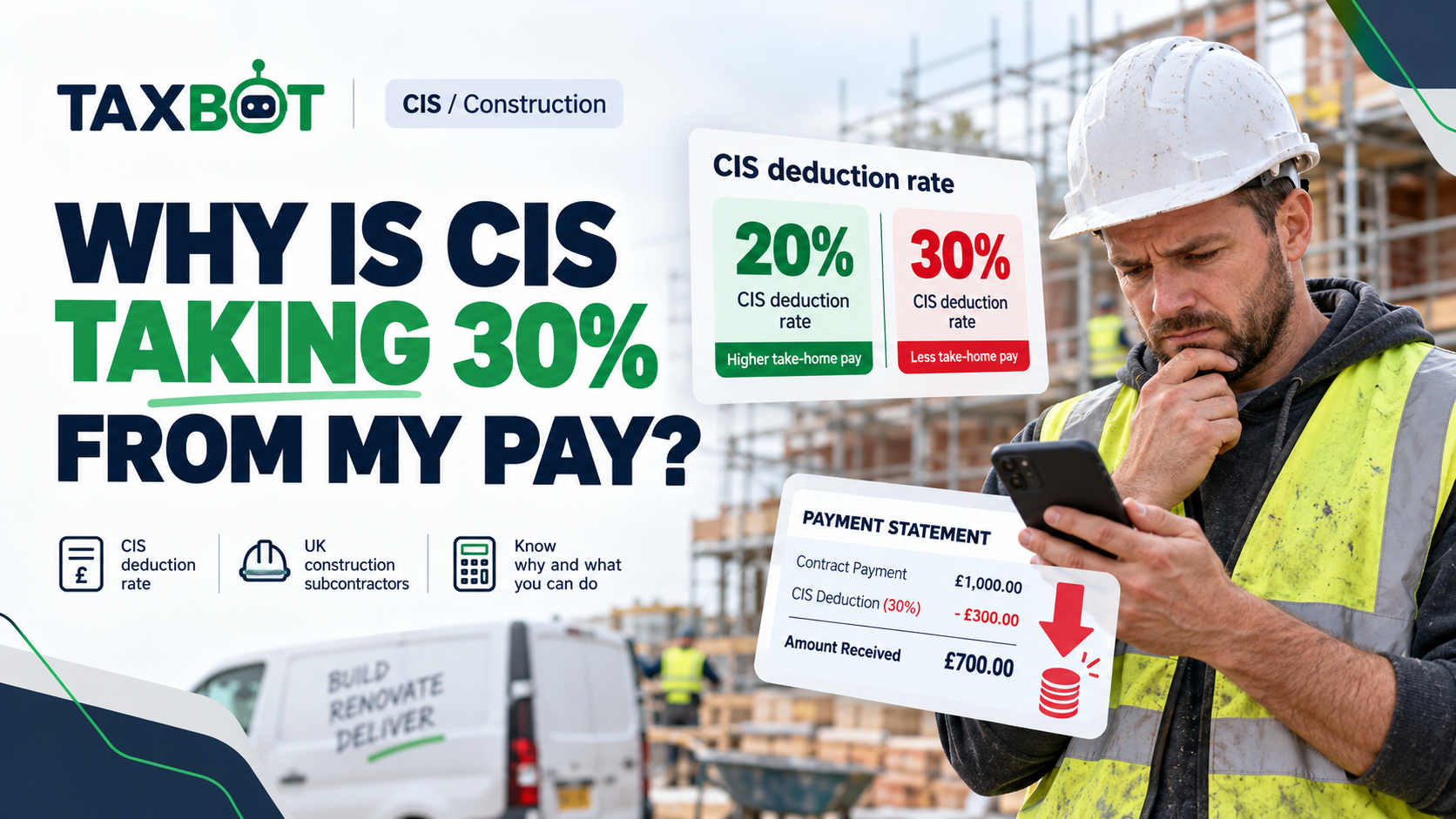
Why Is CIS Taking 30% From My Pay? (And How Do I Get It Changed?)
You've finished a week's work, sent your invoice and waited for the money to arrive.
But when the contractor pays you, something doesn't look right.
Instead of deducting the usual 20% CIS, they've taken 30%.
That's a fair chunk of money, particularly when you've still got fuel, van insurance, tools and household bills to pay.
So why has it happened? Have you done something wrong? And, more importantly, can you get that extra 10% back?
The most likely explanation is that HMRC couldn't confirm your CIS registration when the contractor checked your details.
It doesn't necessarily mean you owe more tax. In many cases, it's a registration or verification issue that can be sorted out.
Here's what to check.
First, why does CIS take money from your pay at all?
If you're a self-employed subcontractor working in construction, you'll probably be familiar with the Construction Industry Scheme, better known as CIS.
Under the scheme, contractors usually deduct money from payments for construction work and send it to HMRC on your behalf.
There are three possible deduction rates:
CIS status
Deduction rate
Registered and verified subcontractor
20%
Unregistered or unable to be verified
30%
Approved gross payment status
0%
The money deducted counts towards your eventual tax and National Insurance liability.
It's worth understanding that CIS deductions aren't the same as your final Income Tax bill.
You might have 20% deducted throughout the year but ultimately owe more or less tax once your business expenses, profits and other income are taken into account.
The 30% rate works in a similar way. It's a higher advance deduction, not a special 30% Income Tax rate imposed on you because you're a subcontractor.
Why has your contractor deducted 30% instead of 20%?
There are a few common reasons.
1. You haven't registered for CIS
Registering as self-employed and registering for CIS are related, but they aren't always the same step.
You may have a Unique Taxpayer Reference (UTR), file Self Assessment returns and still not be properly registered as a CIS subcontractor.
If you're not registered for CIS, your contractor must generally deduct 30% rather than 20%.
If you're new to construction work, this is one of the first things to check.
2. Your details don't match HMRC's records
You could already be registered, but the contractor might not be able to verify you.
When a contractor takes you on, they usually need to check your details with HMRC.
For a sole trader, that includes information such as your UTR, National Insurance number and name.
If the information doesn't match what HMRC holds, verification can fail.
For example, perhaps you've started trading under a business name but your HMRC records are still under your personal name.
Or you've given the contractor an incorrect UTR.
Even a straightforward administrative mistake can cause problems.
3. The contractor hasn't successfully verified you
Sometimes the issue is at the contractor's end.
Before paying a new subcontractor, the contractor generally needs to verify them with HMRC and use the deduction rate HMRC provides.
If they cannot obtain a successful match, they may have to apply the higher 30% rate.
That's why it's worth asking what happened during verification, rather than immediately assuming HMRC has changed your status.
4. Your CIS status has changed
If you've previously been paid at 20% but a new contractor suddenly deducts 30%, something may have changed or the new contractor may be using different details.
Ask the contractor what deduction rate HMRC returned when they verified you.
If you believe your registration is correct, contact HMRC to check your current status.
How much extra money are you losing at 30%?
Let's look at an example.
Say you're a self-employed bricklayer and you invoice a contractor for £2,200 of labour.
Assume there are no materials or VAT to take out of the CIS calculation.
Here's the difference.
CIS at 20%
CIS at 30%
Labour invoiced
£2,200
£2,200
CIS deducted
£440
£660
Money paid to you
£1,760
£1,540
That's £220 less in your bank account from one invoice.
Now imagine the same amount of labour being invoiced four times in a month.
At 20%, the total deduction would be £1,760.
At 30%, it would be £2,640.
That's an £880 difference in cash received during the month.
For someone running a small business, that could cover a significant part of their van costs, materials or household expenses.
It isn't necessarily £880 of extra tax in the long run. But it is £880 that you don't have available to spend now.
And that's why getting your CIS status sorted out matters.
What should you do if you're being deducted 30%?
Start with the contractor.
You don't need to begin by making a formal complaint or assuming somebody has made a serious mistake.
Ask them to confirm the deduction rate HMRC returned when they verified you.
Then check the details they used.
Make sure your UTR, legal name and other required information match your HMRC registration.
If you've never registered for CIS, you'll need to do that.
If you already have a UTR, you can normally register as a CIS subcontractor through HMRC's online service.
If you don't have a UTR yet, you'll need to register your business for Self Assessment and indicate that you're working as a subcontractor.
Once your registration is in place, ask the contractor to check your details again so the correct rate can be applied to future payments.
Don't assume that giving somebody your UTR automatically means you're registered for CIS.
And don't assume that registering today will automatically reverse deductions already made.
Can you get back the extra 10% that's already been deducted?
Potentially, yes.
But not usually by simply asking HMRC to send you the difference as soon as you register.
If you're a sole trader, CIS deductions are normally credited against the tax and National Insurance you owe through your annual Self Assessment return.
When you complete the return, you report your income before CIS deductions, your allowable business expenses and the CIS amounts already taken by contractors.
HMRC then calculates your tax position.
If the CIS deducted is more than your final liability, you may be entitled to a refund.
If the deductions don't cover everything you owe, you may still have tax to pay.
What if you've been deducted 30% all year?
Suppose you've received £36,000 in labour-only CIS payments over the tax year, before deductions.
At 20%, the deductions would total £7,200.
At 30%, they would total £10,800.
That's an extra £3,600 deducted during the year.
However, that doesn't automatically mean you're due a £3,600 tax refund.
Your final tax position will depend on your taxable profits, expenses, other income and the deductions HMRC has recorded.
You could be entitled to a refund, but the figure needs to be calculated properly.
If the contractor has applied the wrong rate or reported incorrect amounts, ask them to investigate and correct the records where appropriate.
Don't forget about your materials
Here's something else worth checking when you receive your CIS payment statement.
CIS isn't always deducted from the entire invoice.
If you've purchased qualifying materials directly for a construction job, the relevant cost can usually be excluded from the amount on which CIS is calculated.
Imagine you're a plasterer and you send this invoice:
Invoice item
Amount
Labour
£1,800
Materials you purchased directly
£400
Total
£2,200
Assume you're not VAT registered, the £400 is an eligible direct materials cost and there are no other adjustments.
The CIS calculation should generally be based on £1,800 rather than the full £2,200.
At the 30% rate:
£1,800 × 30% = £540 CIS deducted
You would receive £1,660.
If 30% were incorrectly applied to the whole £2,200, the deduction would be £660 instead.
That's £120 more withheld.
Keep your materials receipts and make sure the contractor has the information needed to calculate deductions correctly.
Be aware that not everything you buy or charge for counts as deductible materials for CIS purposes. Travel costs, for example, don't become excluded materials simply because they're listed separately on an invoice.
VAT treatment also needs to be considered separately if you're VAT registered.
What should your CIS payment statement show?
Your contractor must provide a payment and deduction statement when making CIS deductions.
This is an important document, and it's worth checking it every time.
At a minimum, you want to understand the amount paid and how much CIS has been deducted.
If something doesn't match your invoice, query it while the job is still fresh in everyone's mind.
For example, you might notice that the contractor has deducted 30% when you expected 20%.
Or perhaps materials you supplied have been included in the deduction calculation.
If you can't make sense of the figures, ask for an explanation.
Don't leave it until the end of the tax year when you're trying to piece together payments from several contractors.
Contractors must provide the statement within 14 days of the end of the relevant tax month. If you haven't received one, ask for it.
A simple habit that makes CIS easier to manage
If you're working for different contractors, the deductions can become difficult to keep track of.
One contractor might pay every Friday. Another might pay fortnightly. You might buy materials for one job, hire equipment for another and have fuel expenses spread across several sites.
Then January arrives, and you're trying to remember which payments had 20% deducted, which had 30%, and whether you've collected all the statements.
Instead, try keeping three figures together every time you're paid:
1. The gross income before CIS deductions.
2. The CIS amount deducted by the contractor.
3. The actual amount you received.
Add the contractor's name and payment date, and keep the corresponding statement.
This also makes it easier to spot an unexpected change in your deduction rate.
TaxBot is designed to help self-employed workers record their income, expenses and CIS deductions as they go, rather than relying on a pile of paperwork at the end of the year.
It won't change the rate HMRC has told your contractor to apply, but maintaining accurate records can make a real difference when it's time to complete your tax return.
Can you stop CIS deductions altogether?
There is another option, although not everyone will qualify.
Some subcontractors can apply for gross payment status.
If HMRC approves your application, contractors can pay you without making the usual CIS deductions.
That means you receive the full qualifying payment and take responsibility for paying the relevant tax yourself.
However, HMRC applies eligibility tests.
These cover areas such as the nature of your business, tax compliance and turnover.
For a sole trader, one of the turnover requirements is generally at least £30,000 over the previous 12 months, excluding VAT and the cost of materials.
Meeting that turnover figure alone doesn't guarantee approval.
And gross payment status doesn't mean you no longer owe tax. It simply changes when the money is collected.
For someone who struggles to put money aside, having no CIS deducted could actually make budgeting harder.
What if the contractor refuses to help?
If you've checked your registration and believe the wrong rate has been applied, explain the issue to the contractor and ask them to review their verification and payment records.
Keep copies of the correspondence, invoices, bank payments and CIS statements.
If you still can't resolve it, contact HMRC for guidance.
Your accountant can also help reconcile the deductions and identify any discrepancies before you submit your tax return.
There's no benefit in allowing incorrect records to build up throughout the year.
Before your next payment arrives
If you're being deducted 30%, don't just accept that it's something every subcontractor has to deal with.
Check whether you're registered for CIS, make sure the contractor has the correct details and find out whether HMRC has successfully verified you.
If the higher rate has been applied correctly because you weren't registered, getting your registration sorted out should help you avoid the same issue on future payments once the contractor can verify you at the standard rate.
As for money already deducted, keep the statements. Those deductions count towards your tax position, and you may be entitled to some money back when your Self Assessment is calculated.
The main thing is to deal with it early.
Ten per cent might not sound like much when somebody says it quickly, but when it's coming off every invoice, it can make a noticeable difference to your cash flow.
This article is intended primarily for self-employed CIS subcontractors operating as sole traders. Limited companies and partnerships may have different procedures for reporting and recovering CIS deductions.
Disclaimer: This article provides general information and is not individual tax or financial advice. Your entitlement to relief or a refund depends on your circumstances. Check current HMRC guidance or consult a qualified UK tax adviser if you're unsure about your CIS status or deductions.
Handle your MTD returns automatically
Snap receipts, log income, submit to HMRC — all from Telegram.
Try TaxBot →