HMRC Guides
Why Is My Tax Bill Bigger Than Expected? Understanding Payments on Account
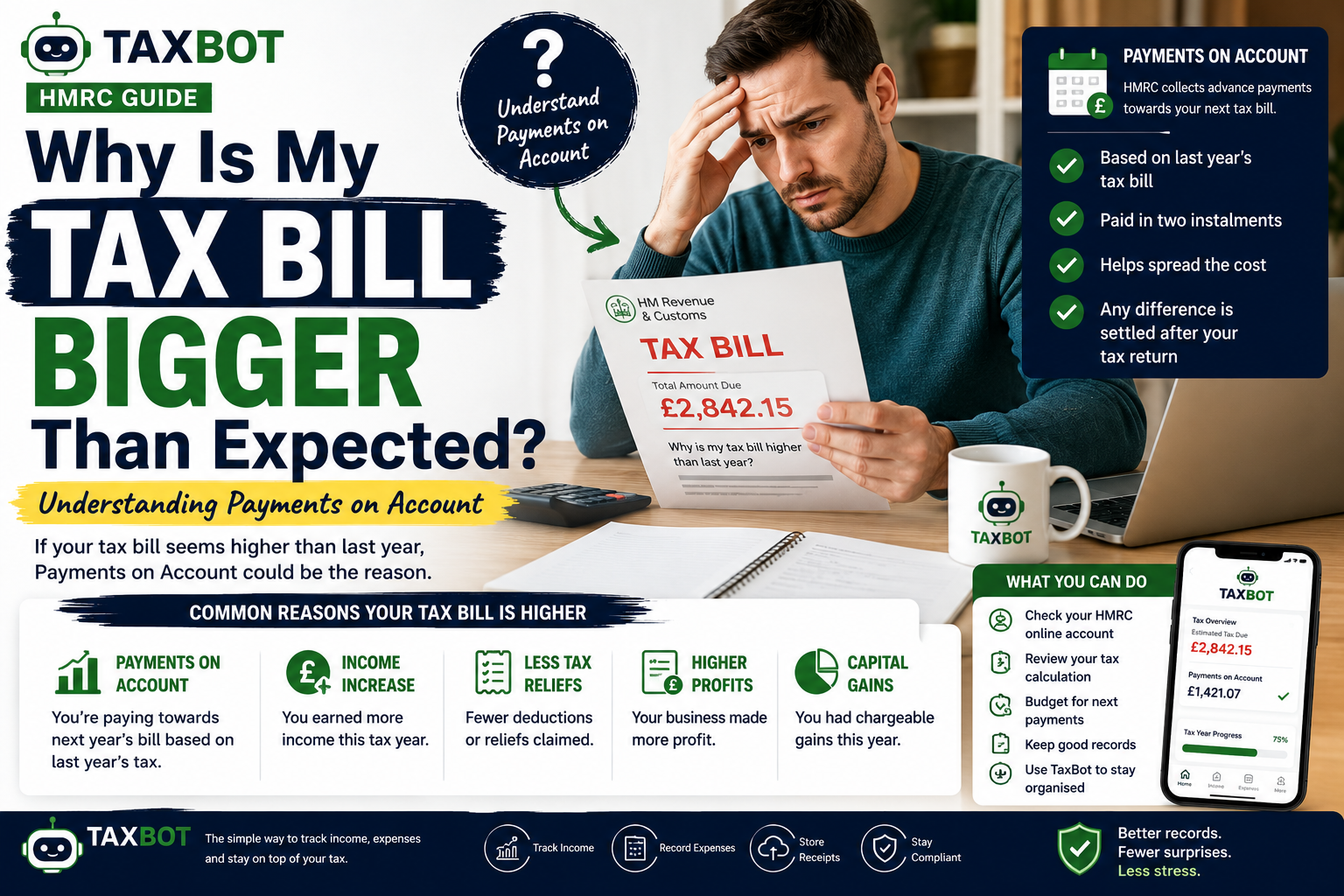
Why Is My Tax Bill Bigger Than Expected? Understanding Payments on Account
If you've logged into your HMRC account and seen a number that's noticeably higher than the tax you actually calculated for the year, you're not imagining it — and you haven't necessarily done anything wrong. The most likely explanation is "payments on account," and with the 31 July deadline approaching, it's worth understanding exactly what these are and why HMRC asks for them.
What are payments on account?
According to HMRC, payments on account are advance payments towards your next tax bill, including Class 4 National Insurance if you're self-employed. They exist to spread the cost of your tax across the year rather than asking you to pay everything in one lump sum after the tax year has ended. Each payment is normally half of the tax you owed the previous year, and the two instalments are due by midnight on 31 January and 31 July.
Do you have to make them?
Not everyone does. Payments on account generally apply if both of the following are true: your last Self Assessment bill was more than £1,000, and less than 80% of the tax you owed was already collected at source — for example through your tax code, or because your bank deducted tax on savings interest automatically. If you don't meet both conditions, payments on account won't apply to you.
Why does the January bill feel so much bigger?
This is the part that catches most first-time filers off guard. If your tax bill for the year is more than £3,000 (the combined total of two payments on account), you'll also need to make a balancing payment by 31 January, on top of your first payment on account for the year ahead. So if your actual tax owed for the year is £3,000, the total due by 31 January could be £4,500 — the £3,000 you owe, plus a £1,500 advance payment towards next year. You then pay a further £1,500 by 31 July.
If your total tax for the year comes to exactly £3,000, you may find the only payment due by 31 January is your first payment on account for the following year — because the previous year's bill has already been settled through the prior year's payments on account.
What if you think your next bill will be lower?
If you know your income is going to be lower than last year — perhaps a contract ended, you've moved into employment, or your business has had a quieter year — you can ask HMRC to reduce your payments on account. This can be done online through your Self Assessment account by selecting "Reduce payments on account," or by post using form SA303.
It's worth being realistic rather than optimistic here. If you reduce your payments on account and your actual tax bill ends up higher than the reduced amount, HMRC will charge interest on the difference, calculated from the original due dates.
Checking your own figures
You can see your payments on account, what's due, and the deadlines by signing into your HMRC online account and viewing your latest Self Assessment statement. If you filed a paper return, the same information is shown on your Self Assessment statement sent by post. If you submitted your return very close to a payment deadline, you may not receive a statement in time — in which case, your tax calculation is the most reliable way to work out exactly what you owe.
If you're struggling to pay
If you can't pay a payment on account in full by the deadline, it's best to act before the date passes rather than after. HMRC has a "Time to Pay" option that lets eligible taxpayers set up an instalment plan online if they owe less than £30,000 and meet the relevant criteria. Interest is still charged on anything outstanding, but acting early can help you avoid additional penalties on top of that.
Disclaimer: This article is for general information only and is based on HMRC's published guidance on GOV.UK, correct as of June 2026. It does not constitute tax or financial advice, and individual circumstances can affect how these rules apply to you. If you're unsure how much you owe, whether payments on account apply to you, or whether to reduce a payment, you should check your HMRC online account or speak to a qualified accountant or tax adviser.
Handle your MTD returns automatically
Snap receipts, log income, submit to HMRC — all from Telegram.
Try TaxBot →